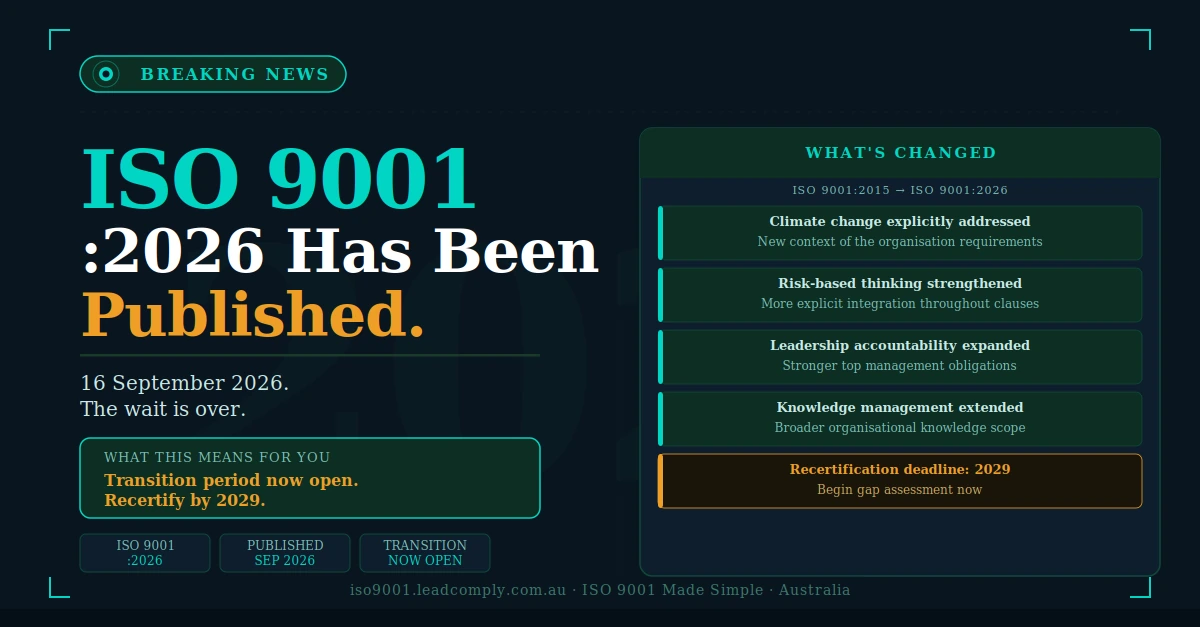
ISO 9001:2026 was published on 16 September 2026. It is the first substantial revision to the world’s most widely used quality management standard in more than a decade.
Back in May we wrote that the new version was coming, and in June we covered what was expected to change and how Australian businesses should prepare. It is now here.
The headline for anyone holding a certificate is that the standard has been updated, not rewritten. The ten-clause structure is unchanged. The substantive additions are that climate change now has to be considered as part of your organisational context, that ethical behaviour and quality culture are named leadership responsibilities, and that risk and opportunity have been separated more clearly with more weight given to opportunity. The revision also ships with a new Annex A, roughly fifteen pages of official guidance on how to interpret the clauses, which is the first time ISO 9001 has included anything of the kind.
Certified organisations will need to transition. The convention with standards of this kind is a three year window, which would put the deadline around September 2029. That date is not yet formally confirmed. The binding deadline is set by the International Accreditation Forum and issued in a communique after publication, so anyone stating it as settled fact this month is getting ahead of the paperwork. Three years remains the sensible planning assumption.
If you are not certified, nothing about your situation changed on 16 September. The work in front of you is the same work it was a month ago, and the standard you would now be working toward comes with its own interpretation guidance attached.
We have published a full plain-English breakdown on the Lead Comply ISO 9001 Portal blog, covering what changed clause by clause and what it means depending on whether you are already certified, part-way through certification, or still deciding. You can read it here: ISO 9001:2026 Is Published. What It Actually Means for a Small Australian Business.
Lead Comply does not issue ISO 9001 certification. That is done by independent, accredited certification bodies. What we do is help Australian small businesses get their quality system ready for that process, and keep it ready afterwards.
