For most of this year, anyone writing about ISO 9001:2026 (us included) had to add the same caveat. The transition would probably run for three years, probably to September 2029, but nobody could confirm it until the accreditation community published its rules.
That caveat can now go. The rules have been published, and the key dates are locked in. Here is what is confirmed, what still depends on your certification body, and what it means for an Australian small business.
Who sets the deadline, and why the name has changed
ISO writes the standard, but it does not decide how long businesses have to switch over. That is set by the international accreditation community, the network of bodies that oversee certification worldwide.
If you have read about ISO transitions before, you will know this body as the International Accreditation Forum (IAF). On 1 January 2026, the IAF and its sister organisation for laboratories merged into a single body, Global ACI (Global Accreditation Cooperation Incorporated). Same role, new name.
In Australia, those rules are applied by JAS-ANZ, the Joint Accreditation System of Australia and New Zealand. JAS-ANZ accredits the certification bodies that audit your business, so its timeline and your certification body’s timeline both flow from the Global ACI document.
That document, formally titled Global ACI-TECH-3-TR 2029-09-30 (M), Transition Requirements for ISO 9001:2026, was published on 16 September 2026, the same day ISO released the new standard.
The dates that are now confirmed
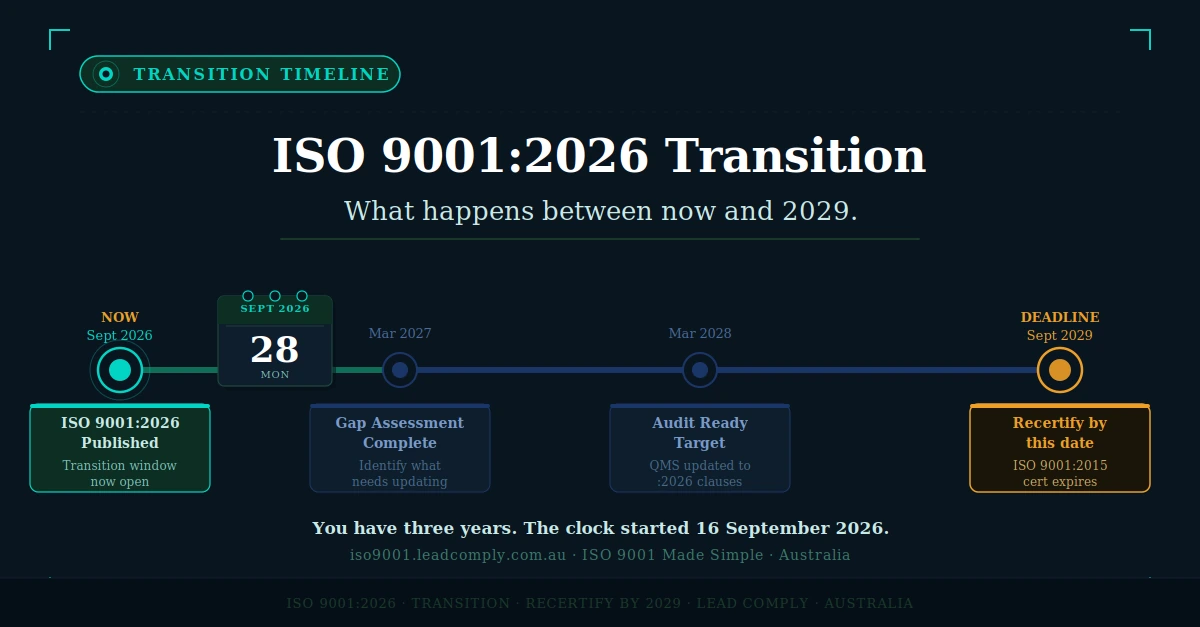
Here is the full timeline, in plain English:
- 16 September 2026: ISO 9001:2026 is published and the transition period begins.
- 31 March 2027: accreditation bodies (JAS-ANZ, for us) must be ready to assess certification bodies against the 2026 version.
- 30 June 2027: certification bodies lodge their transition declarations with their accreditation body.
- 30 September 2027: accreditation bodies complete their decisions on certification bodies’ transitions.
- 31 March 2028: from this date, new and initial accredited certificates can only be issued to ISO 9001:2026. No more first-time 2015 certificates.
- 30 September 2029: the final deadline for certified organisations to complete their transition.
The first three dates are behind-the-scenes steps for the auditors, not for you. But they matter, because they tell you when your certification body is likely to be able to audit you against the new version. We come back to that below.
If you already hold an ISO 9001:2015 certificate
You have until 30 September 2029 to transition. The requirements allow it to happen at a scheduled surveillance audit (your yearly check-up), at a recertification audit (the full review every three years), or at a separate transition audit.
“Complete” means the audit has been done and any findings closed out, not just booked. So your real deadline is a few months earlier than the date on the page.
If you are working toward certification now
The date to watch is 31 March 2028. If you want a 2015 certificate, it has to be issued before then. After that, every new certificate is to the 2026 version. Your certification body may also choose to stop earlier, so do not assume you have right up to that date.
If you are deciding whether to finish on 2015 or build to 2026, we have written a practical guide for that exact situation: I’m halfway through ISO 9001 certification. Do I certify to 2015 or wait for 2026?
What is still not confirmed
The Global ACI dates set the outer boundaries. Inside them, several things are still up to your certification body, and you will not find the answers in any article.
- When your certification body can audit you to 2026. Each certification body has to be assessed and approved for the new version, and they will get there at different points across 2027. Some may be ready earlier than others.
- How much extra audit time the transition adds. Extra audit time means extra cost. The requirements do not set a fixed amount, so ask for a quote.
- Whether they will stop issuing 2015 certificates before 31 March 2028. That date is the latest possible cut-off, not a guarantee.
- What exactly happens to your certificate if you miss the deadline. The practical effect is well understood from past transitions: an accredited 2015 certificate cannot carry on past the end of the transition. How that is handled for your certificate, and what it costs to recover, is administered by your certification body. Get their answer in writing.
Why three years is shorter than it sounds
Three years feels like plenty of time. Look at the timeline again, though. Accreditation bodies do not have to be ready until March 2027, and certification body approvals run through to September 2027. For many businesses, a 2026 audit may not realistically be available until some time in 2027.
That leaves roughly two years in which the world’s ISO 9001 certificate holders all need to be audited. Global ACI puts the number of accredited ISO 9001 certificates at more than one million. The certification bodies are the same ones auditing everyone else, and they will not suddenly double their auditor numbers in 2029.
Past transitions have tended to follow the same pattern: a quiet first year, a steady middle, and a scramble at the end where audit dates get hard to find. The businesses that transition calmly are the ones that pick a date in the middle of the window and plan backwards from it.
What to do this month
Nothing dramatic. Send your certification body an email with three questions:
- When do you expect to be approved to audit against ISO 9001:2026?
- Can our transition happen at our next surveillance or recertification audit, and how much audit time will it add?
- If we are working toward certification now, when will you stop issuing new 2015 certificates?
Their answers will shape your timeline more than anything else. Then have a look at what actually needs changing in your system. For most small businesses it is a short list, not a rewrite. Our guide to which documents change for the 2026 version walks through it, and what ISO 9001:2026 actually means for a small Australian business explains each change in plain English.
Get your transition on the calendar, not in the too-hard basket
Lead Comply helps Australian small businesses get ISO 9001 ready without the jargon. Start with a free gap analysis in the Lead Comply ISO 9001 Portal to see exactly where your system stands against the 2026 version. If you would rather talk it through, book a complimentary assessment and we will help you map out a transition plan that fits your audit cycle.
