AI in Real Estate Agencies: Where It Helps and Where It Can Hurt
AI in real estate in Australia has moved from novelty to everyday tool in a very short time. Agents use it to write listings, edit photos, follow up leads and sort through rental applications. Used well, it saves hours every week.
But real estate is a trust business with a lot of rules. Listings must not mislead, tenant decisions must be fair, and since July agencies hold even more sensitive customer information for anti money laundering checks. This article looks at where AI helps, the five areas where it can hurt, and the simple checks that keep your agency safe.
How agencies are using AI today
Most agencies we speak with use AI in at least three or four of these ways, often without anyone keeping track:
- Writing property descriptions, social media posts and email campaigns
- Editing photos, removing clutter or virtually staging empty rooms
- Drafting appraisal reports and comparable sales summaries
- Website chatbots and automatic lead follow up
- Scoring or sorting rental applications
- Recording and summarising calls, inspections and meetings
- Drafting routine emails to landlords, tenants and buyers
AI in real estate in Australia: five risk areas
1. Listings that mislead
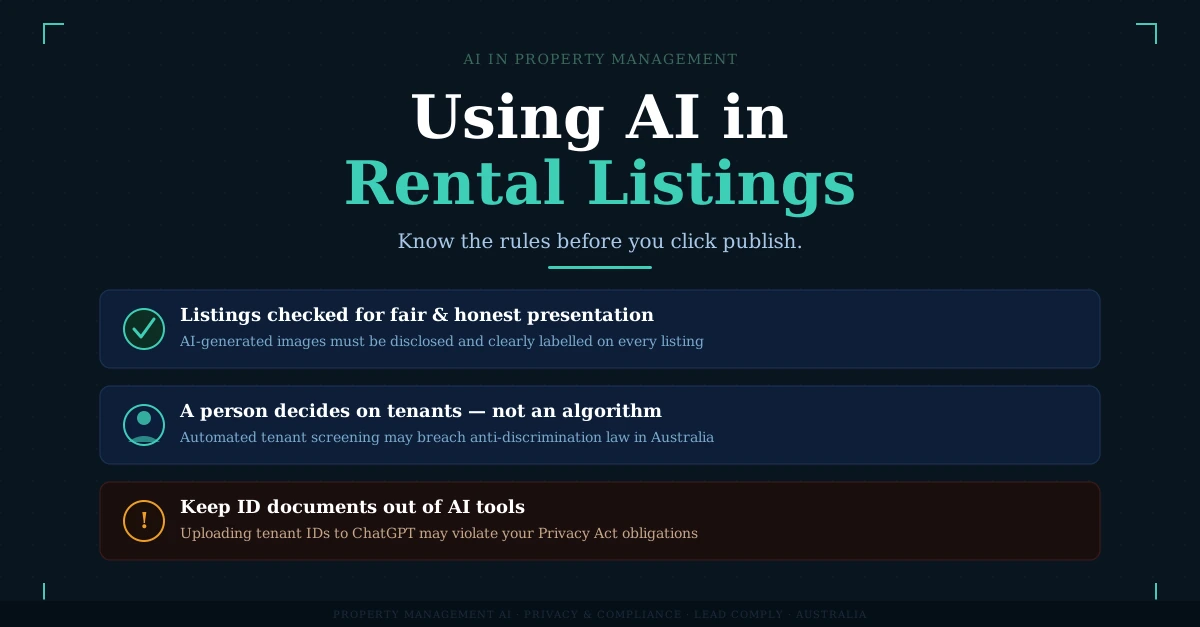
AI can write a glowing listing in seconds. It can also invent features, get measurements wrong or describe a “short walk to the station” that is actually a bus ride. Under the Australian Consumer Law and state fair trading laws, the agency is responsible for every claim in the ad, whoever or whatever wrote it.
Photos matter too. In September 2026, the NSW Government announced new rules for rental listings. Landlords and agents will need to disclose when photos have been digitally altered or made by AI to hide damage or flaws. The changes are planned for early 2027, with fines of up to $22,000. Even before then, an edited photo that gives a false impression can be misleading.
The check: an agent checks every AI written listing against the property details, and any virtually staged or edited photo is clearly labelled.
2. Unfair tenant decisions
Tenant application platforms increasingly score or rank applicants. A tool that learns from past data can treat some groups unfairly without anyone noticing. Anti discrimination laws still apply when software helps make the decision.
If the Privacy Act covers your agency, there is a privacy rule too. From 10 December 2026, your privacy policy must explain when software plays a key part in significant decisions about people. Access to housing is one of the OAIC’s own examples. Our article on the OAIC’s automated decision making guidance explains what to add.
The check: a property manager reviews every score and makes the final decision. Now and then, look over the results for patterns that don’t look right.
3. Personal information going into the wrong tools
Agencies handle a lot of personal information: contact details, income, rental history, references and identity documents. When staff paste these into a free AI tool to draft a letter or summarise an application, that information leaves the agency.
Not sure whether the Privacy Act applies to your agency? Many small agencies are under the $3 million turnover threshold, but there are important exceptions. Our guide to the $3 million test walks you through it.
The check: clear rules on what staff must never put into AI tools, and a list of approved tools. Our one page guide on what staff should never put into ChatGPT is a good place to start.
4. AML/CTF records and identity checks
Since 1 July 2026, real estate agents who provide certain services have obligations under the anti money laundering and counter terrorism financing laws. These include checking customer identity, monitoring for suspicious activity and keeping records for at least seven years.
That brings two AI questions. First, identity documents and due diligence records are exactly the kind of information that must never go into a general AI tool. Second, many identity checking products now use AI. They can help, but the agency stays responsible for its AML/CTF program, so check how the supplier works and where your customers’ data is stored.
There is a privacy angle too. For a small agency, the Privacy Act applies to the personal information handled for these obligations, even if the agency is otherwise exempt.
5. Price estimates and chatbot answers
AI valuation tools and chatbots can give buyers and sellers a price estimate in seconds. If that estimate is treated as your agency’s price guide, it needs to meet your state’s rules on quoting prices. A chatbot might give a buyer the wrong price range, or promise something the agency can’t deliver. That is the agency’s problem, not the software company’s.
The check: keep chatbots to general questions, make it easy to reach a real person, and make sure price guides always come from an agent.
A simple checklist for your agency
- We have a list of every AI tool our agency uses, including free ones
- Each tool has a named person responsible for it
- Staff know what information must never go into AI tools, especially ID documents
- Every AI written listing is checked by an agent before it goes live
- Edited or virtually staged photos are clearly labelled
- A person makes the final decision on every rental application
- Our privacy policy covers automated decisions, if the Privacy Act applies to us
- We have checked how any AI identity checking tool stores customer data
What this looks like in practice
Picture an agency with twelve staff across sales and property management. The principal spends an afternoon listing every AI tool the team uses. The list includes a listing writer, a photo editing app and a tenant application platform with scoring. Several staff also use a free chat tool for emails.
The free chat tool is replaced with an approved business version, and staff get a one page guide on what to keep out of it. Listings get a quick fact check before publishing, and staged photos are labelled. Property managers keep the final say on every application, and the privacy policy gets a new section before December. The whole review takes less than a day, and the agency can now answer clearly when a landlord asks how it handles their tenants’ information.
Questions agency principals are asking
Can we still use virtual staging?
Yes. Label it clearly so nobody is misled, and keep an untouched photo set on file. Watch for the NSW rental rules planned for early 2027, and check whether your state has similar plans.
Is it OK to use AI to summarise rental applications?
Only with a tool approved for personal information, and only if a property manager still reads the application and makes the decision.
Does our AML/CTF program need to mention AI?
If AI tools play a part in identity checks or monitoring, it makes sense for your program and risk assessment to say how. That is worth discussing with whoever helps you with your AML/CTF program.
Where do we start?
With a list of the AI tools your team uses. Most agencies find more than they expected.
The short version
AI can save an agency real time, but the agency stays responsible for every listing, decision and record. Check AI written listings and label edited photos. Keep a person in charge of tenant decisions, and keep identity documents and personal information out of general AI tools. With AML/CTF obligations now in place, getting this right matters more than ever.
This article is general information, not legal advice. Please get advice about how the rules apply to your agency.
How Lead Comply can help
Lead Comply works with real estate agencies on both AML/CTF and AI governance, so we understand how the two fit together. Book a complimentary assessment and we will walk through your agency’s AI use and compliance with you. You can also start free in the Lead Comply AI Governance Portal to build your agency’s AI register and policy today.
