If you’ve just enrolled with AUSTRAC and started building your program, you might be picturing another looming deadline right around the corner. Here’s some genuinely reassuring news: your first Annual Compliance Report isn’t due for a while yet, and understanding exactly when, and what it actually asks for, means you can prepare properly rather than scrambling later.
Here’s what the report actually is, when your agency’s first one is due, and what it means for how you should be running your program between now and then.
What the Annual Compliance Report actually is
Unlike a Suspicious Matter Report or a Threshold Transaction Report, which relate to specific transactions, the Annual Compliance Report is a program level check in. It’s your agency’s own account, submitted to AUSTRAC, of how you’ve met your AML/CTF obligations over the reporting period. Think of it less as reporting an event and more as a structured, periodic self assessment of whether your program has actually been functioning as intended.
This matters because it changes what “getting ready” for it actually looks like. You’re not preparing for a single moment, you’re demonstrating a pattern of genuine, ongoing compliance across the whole period the report covers.
When your agency’s first report is actually due
This is worth being precise about, because AUSTRAC has recently changed how the reporting period works, moving from a calendar year basis to a financial year basis. If you come across older guides online describing a January to March submission window, that reflects the previous system, not the current one.
Under the current arrangement, the reporting period aligns with the financial year, 1 July to 30 June, and the report must be submitted within three months of that period ending, meaning the submission window runs from 1 July to 30 September each year. For real estate agencies, whose AML/CTF obligations commenced on 1 July 2026, this works out cleanly: your first reporting period runs from 1 July 2026 to 30 June 2027, and your first Annual Compliance Report will be due for submission sometime between 1 July and 30 September 2027.
That gives you close to a full year of actually running your program before you need to formally report on it. Genuinely useful time, provided you use it to build good habits now rather than treating the deadline as distant enough to ignore.
What the report broadly asks you to demonstrate
While the exact questions on the form can be updated by AUSTRAC over time, the report is generally structured around confirming the substance of what we’ve covered throughout this whole series: that your program exists, is current, and has actually been operating, not just sitting as a document nobody’s touched.
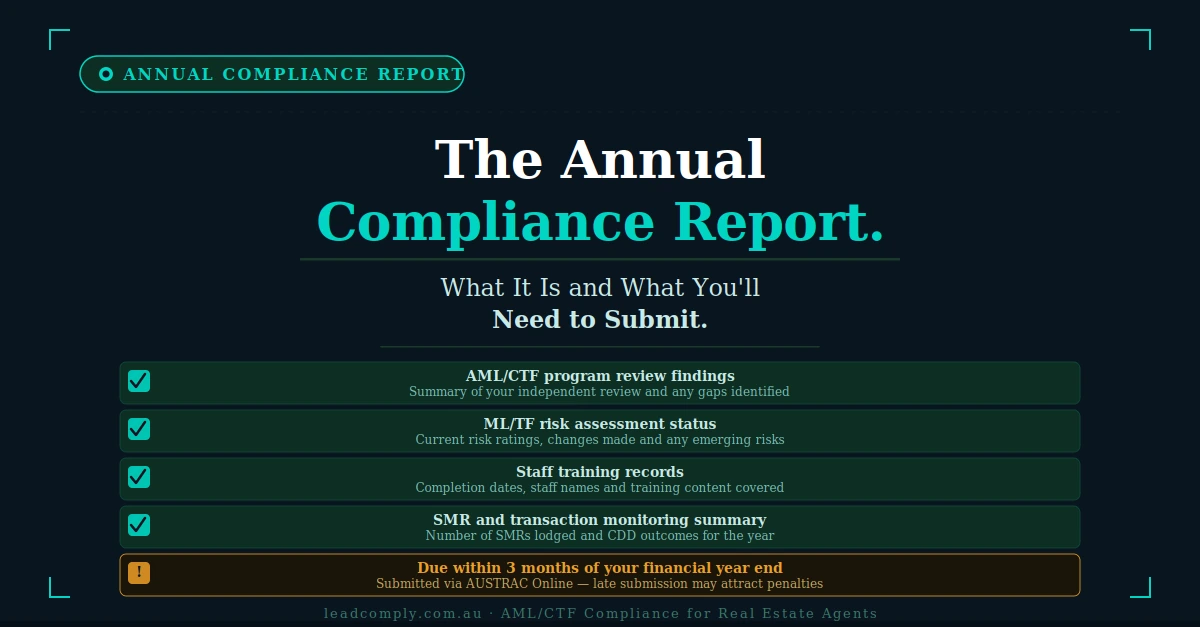
Broadly, you can expect to need to speak to things like whether your AML/CTF program was in place and current throughout the period, whether staff training was delivered and evidenced, how your customer due diligence and screening practices actually operated, and details of any Suspicious Matter Reports, Threshold Transaction Reports, or other reports lodged during the period. In effect, the report asks you to demonstrate the same things a genuine independent review would look for: does the paper trail match the practice, consistently, across the reporting period.
Why this is good news if you’ve built your program properly
If you’ve genuinely maintained your program the way we’ve described across this whole series, kept your risk assessment current, refreshed training properly, tracked document versions, scheduled an independent review, this report becomes largely a matter of pulling together evidence you already have, rather than assembling something from scratch under time pressure.
The agencies who struggle with this report are, predictably, the ones who built a program once, filed it away, and didn’t maintain it. If your risk assessment hasn’t been touched since it was written, if training records are patchy, if you can’t quickly produce evidence for the period being reported on, the Annual Compliance Report is exactly where that gap becomes visible to AUSTRAC directly, not just a theoretical risk sitting in a drawer.
Who actually submits it
To submit a compliance report, you need to be listed as an administrator on your agency’s AUSTRAC Online account, and there’s no limit on how many administrators an account can have, so this doesn’t need to sit with just one person. If your agency is part of a reporting group, such as a franchise network, generally only one member submits on behalf of the group, though any individual member can lodge their own report separately if their circumstances differ substantially from the rest of the group. If this applies to your situation, it’s worth revisiting our piece on multi office and franchise compliance structures, since the same question of who’s actually the reporting entity applies here too.
How to actually prepare, well ahead of time
The mistake to avoid is treating September 2027 as a date that’s comfortably far away right now, and then discovering in August 2027 that a year’s worth of evidence hasn’t been consistently gathered. Build the habit now: keep training records current as you go, maintain your document version log properly every time something changes, and treat your compliance report preparation as a natural extension of the annual program review we’ll cover separately, rather than a separate task competing for attention in its own right.
If your program is genuinely being run the way it’s meant to be, by the time the submission window opens, you should be able to answer the report’s questions by pointing to evidence that already exists, rather than needing to generate it retrospectively.
Where Lead Comply fits into this
Everything in this whole series, the risk assessment, the training records, the document control, the independent review, feeds directly into being able to answer the Annual Compliance Report honestly and completely when the time comes. The Lead Comply AML Portal keeps this evidence organised as your team works, rather than scattered across emails and desktops that need to be pieced back together under deadline pressure a year from now.
If you’d like an honest read on whether your current program would genuinely hold up when it comes time to report, our free 30 minute Compliance Gap Audit is a useful place to start well before the pressure of an actual submission window arrives.
Create your free account and book No Obligation Compliance Gap Audit→ Lead Comply AML Portal
