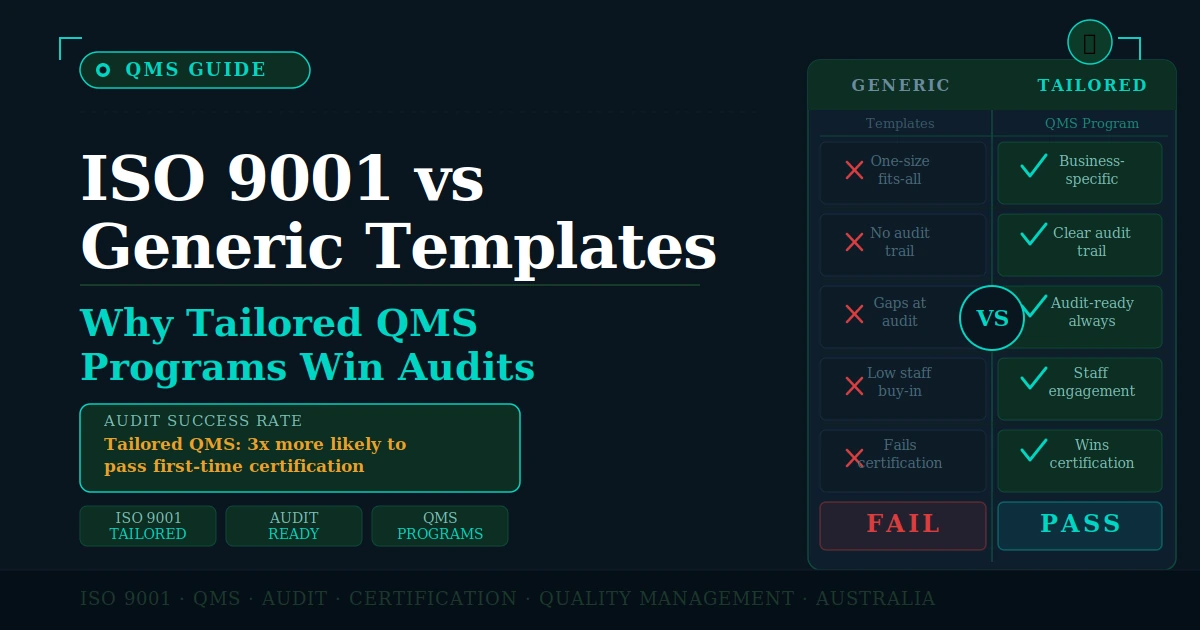
ISO 9001 vs Generic Templates: Why Tailored QMS Programs Win Audits
Every year, Australian businesses fail ISO 9001 audits with documents that look complete on paper. The common thread is almost always the same — a generic template that was never properly adapted to how the business actually operates. Here is what auditors are really looking for, and why a tailored QMS consistently outperforms a template.
The ISO 9001 certification market is flooded with templates. A Google search returns hundreds of options, downloadable packs, software platforms, and consultants who deliver the same document set to every client regardless of industry, size, or operating model. They are attractive because they are fast, cheap, and give the appearance of a complete Quality Management System.
The problem becomes apparent at the audit. A certification auditor’s job is not to confirm that you have a set of documents. It is to verify that your QMS reflects how your business actually works and that your team genuinely understands and follows it. A generic template almost never passes this test without significant additional work. And in many cases, by the time the gaps become apparent, the business has already spent time and money it will need to spend again.
This article explains what auditors are actually looking for, where generic templates consistently fail, and what a genuinely tailored QMS looks like, from the perspective of a Sydney ISO 9001 consultant who has conducted internal audits across multiple industries.
| About Lead Comply’s ISO 9001 perspective: Danny Huynh is a BSI Certified Lead Internal Auditor with over a decade of hands-on experience designing and maintaining ISO 9001 Quality Management Systems in a regulated industry. Lead Comply works with Australian SMEs in Sydney and across Australia to design QMS programs that reflect how their business actually operates, not how a template assumes it does. |
What ISO 9001 Certification Auditors Actually Look For
Understanding why templates fail requires understanding what an ISO 9001 certification audit is actually assessing. Many business owners assume the auditor is checking whether the documents are present and correctly formatted. That is not the audit.
A certification auditor is conducting a conformity assessment: verifying that the organisation’s quality management system conforms to the requirements of ISO 9001:2015 across seven core clauses: context of the organisation, leadership, planning, support, operation, performance evaluation, and improvement. For each clause, the auditor is asking three questions:
- Is the requirement documented in your QMS?
- Is the documented process what your team actually does?
- Can your team demonstrate that they follow it consistently?
A generic template can sometimes answer the first question. It almost never answers the second or third because it was not designed around your team’s actual processes.
| ⚠️ THE AUDIT QUESTION A TEMPLATE CANNOT ANSWER Auditors routinely ask staff members to walk through a process described in the QMS. If the staff member’s description of how they actually work does not match the documented procedure, even if the procedure itself is technically correct — that is a nonconformity. A template describes a generic process. Your staff describe your actual process. If those two things do not match, the audit fails on that clause. This is the fundamental problem with templates and it cannot be fixed by editing the template. It requires the procedure to be designed around how your business actually works. |
The Five Areas Where Generic Templates Consistently Fail
Across ISO 9001 internal audits and certification preparation reviews, the same failure points appear repeatedly in template-based QMS programs. These are not obscure clauses. They are central requirements that templates address generically and auditors examine specifically.
| ISO 9001 Area | What a Template Provides | What an Auditor Expects |
| Context of the Organisation(Clause 4) | A generic list of internal and external issues applicable to “most businesses” | A specific analysis of your actual business context — your market, your regulatory environment, your genuine competitive pressures, and how these shape your QMS scope |
| Interested Parties(Clause 4.2) | A standard list of stakeholders — customers, employees, suppliers, regulators | Your actual interested parties and their specific requirements — documented in terms of how your business understands and responds to each one |
| Operational Planning(Clause 8) | Generic process flow diagrams that could apply to any service business | Your specific operational processes, how your business actually delivers its services, with the controls, checks, and quality points embedded in those real processes |
| Competence and Training(Clause 7.2) | A blank training register and a generic competency framework | Evidence that your team has the specific competencies required for their roles with documented training records that match the actual roles in your business |
| Internal Audit Program(Clause 9.2) | A template audit checklist and an unfilled audit schedule | An actual internal audit that has been conducted, documented, and used to drive improvement with evidence of nonconformities raised and closed |
What a Tailored QMS Looks Like — The Difference in Practice
A tailored QMS starts from a different question. Instead of “what does ISO 9001 require?” which is how a template is built. It starts from “how does this business actually operate, and how do we build ISO 9001 requirements into those real operations?”
The difference appears in every part of the system:
| Template-Based QMS | Tailored QMS |
| Quality policy written in generic language that could apply to any organisation | Quality policy that specifically names the business’s services, clients, and the standards it holds itself to recognisable to anyone who works there |
| Process maps that show an ideal workflow — not the workflow the team actually follows | Process maps built by walking through how the team actually does the work, then documenting that, not an aspirational version |
| Risk register populated with generic operational risks | Risk register that reflects the specific risks relevant to this business’s services, clients, and market — reviewed and updated by the people who manage those risks |
| Objectives set at generic levels — “improve customer satisfaction” | Objectives that are specific, measurable, and tied to how this business tracks performance with real data sources and review cycles the team actually uses |
| Management review template with blank fields | Management review that is genuinely conducted by leadership, with actual performance data reviewed and real decisions made documented accordingly |
Why Sydney SMEs Need a Local ISO 9001 Consultant
Beyond the generic versus tailored distinction, there is a practical case for working with a Sydney-based ISO 9001 consultant rather than a national platform or an offshore template provider.
- Understanding of the Australian regulatory environment particularly for businesses in regulated industries where ISO 9001 intersects with ASIC, AUSTRAC, or sector-specific requirements
- Familiarity with the certification bodies operating in Australia, including how different auditors from different bodies approach specific clauses
- Ability to meet with your team in person, which produces a substantially more accurate understanding of how your business actually operates than any remote questionnaire can
- Ongoing availability after certification: for annual surveillance audits, internal audit support, and the management review cycle that ISO 9001 requires every year
- Understanding of the ISO 9001:2026 revision now in development, and how to build a QMS that transitions smoothly when the updated standard is released
For Sydney SMEs, the cost of a local consultant who builds your QMS correctly the first time is almost always less than the combined cost of a template purchase, a failed certification audit, a corrective action period, and a re-audit which is the more common trajectory for template-based programs.
The Lead Comply Approach to ISO 9001 QMS Design
Lead Comply’s ISO 9001 engagements follow a structured methodology built around your business not around a template.
- Gap assessment: a structured review of your current practices against ISO 9001:2015 requirements, identifying what is already in place and what needs to be developed
- Context mapping: working with your leadership to document your actual business context, interested parties, and QMS scope in terms that reflect your specific operating environment
- Process documentation : documenting your actual operational processes with your team, not overlaying a generic process map on your business
- Objective setting: establishing measurable quality objectives that are tied to your real performance data and reviewed through a management review cycle your team will actually use
- Internal audit program: designing and conducting an internal audit that meets ISO 9001 Clause 9.2 requirements and produces genuinely useful findings
- Certification preparation: preparing your team for the certification audit through a pre-audit review that identifies any remaining gaps before the auditor arrives
Every engagement is delivered personally by Danny Huynh — a BSI Certified Lead Internal Auditor who has been conducting ISO 9001 internal audits for over a decade. Not a junior associate. Not a platform-generated document set. A consultant who understands what auditors look for because he has been on both sides of the audit table.
| ✓ WHAT A CERTIFICATION-READY TAILORED QMS LOOKS LIKE Quality policy written in your business’s own language not generic statements. Context analysis that reflects your actual market, clients, and regulatory environment· Process maps that match what your team actually does — built with your team· Risk register populated with real risks your business manages, not generic examples· Objectives tied to performance data your business actually tracks· Competency records that match the actual roles in your business· An internal audit conducted, documented, and used to close nonconformities· A management review that leadership has genuinely conducted with evidence. This is what passes certification. This is what a template cannot produce without the same amount of work it would take to build the QMS from scratch. |
| 📋 WHAT GOES WRONG IN PRACTICE — WHAT LEAD COMPLY SEES The most consistent finding when Lead Comply reviews template-based QMS program is the same across almost every engagement: 1 — The operational processes in the QMS do not match how the team actually works. Staff describe their process differently from the documented procedure. This produces a nonconformity on Clause 8 every time, regardless of how well the template is written. 2 — The internal audit has either not been conducted, or was completed as a box-ticking exercise with no genuine findings raised. Certification auditors look for evidence of a functioning audit program, not a blank checklist marked “compliant”. 3 — Objectives are not measurable or not tracked. A QMS that sets objectives but has no data supporting their measurement does not demonstrate the performance evaluation ISO 9001 Clause 9.1 requires. Businesses that self-implement using templates are not making compliance mistakes — they are making a methodology mistake. The documents exist. The system does not. |
| Frequently asked questions on ISO 9001 QMS design: How long does it take to get ISO 9001 certified? – Typically 4 to 9 months from engagement to certification, depending on your current practices and the certification body’s audit schedule. What does ISO 9001 certification cost? – The total cost includes consultant fees, certification body fees, and surveillance audit fees. Lead Comply provides transparent pricing at the Clarity Call — not before. Can we use an existing template as a starting point? – A template can be a useful reference point. It cannot be the deliverable. The work of tailoring always exceeds the work saved by the template. Does ISO 9001 apply to service businesses as well as manufacturers? – Yes. ISO 9001 is equally applicable to service businesses and in some respects more straightforward, since service processes are often more directly controllable. |
Book a free 30-minute Clarity Call with Danny Huynh — BSI Certified Lead Internal Auditor. In 30 minutes you will know whether your QMS reflects how your business actually operates and what a certification auditor would find today.
