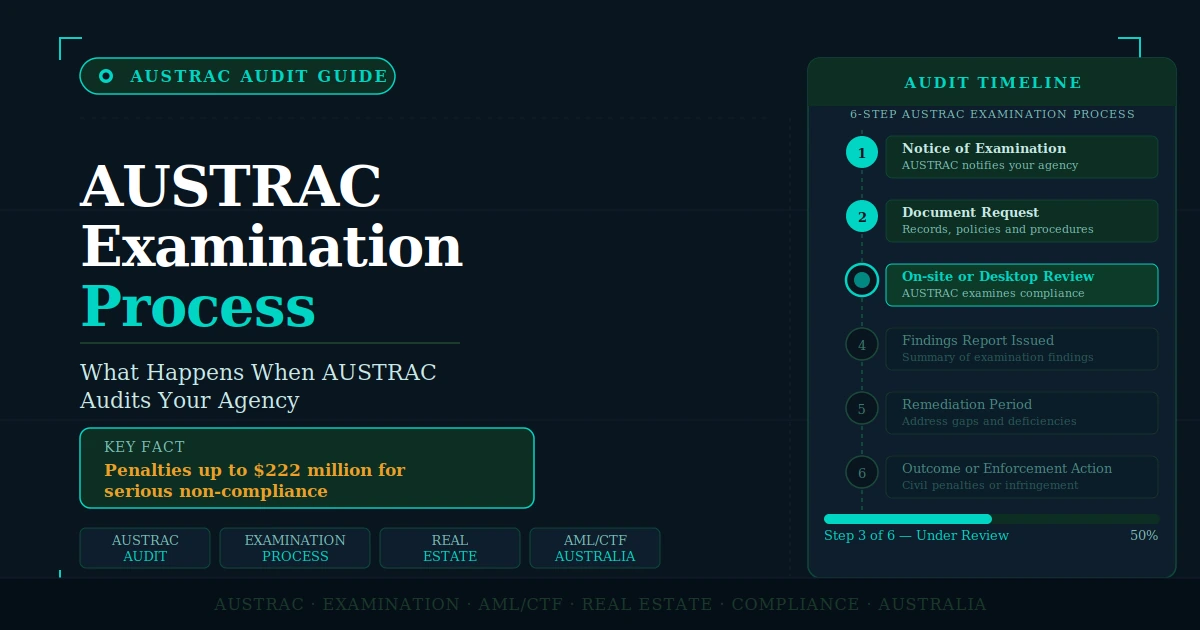
AUSTRAC Examination Process: What Happens When AUSTRAC Audits Your Agency
Every real estate agency that enroll as a reporting entity under Tranche 2 becomes subject to AUSTRAC’s examination and supervisory powers. Understanding what an examination involves, what AUSTRAC looks for, and what the consequences of non-compliance are is essential for every principal who wants to be genuinely prepared rather than merely enrolled.
AUSTRAC is not a passive regulator. It is an active supervisory body with broad powers to examine reporting entities, require production of records, conduct on-site visits, and take enforcement action where non-compliance is identified. For real estate agencies entering the AML/CTF framework on 1 July 2026, this supervisory relationship begins from the first day of 1 July 2026.
The natural question for any agency principal is: what does an AUSTRAC examination actually look like, and how likely is it to happen to us? The honest answer is that AUSTRAC’s examination program for Tranche 2 entities will ramp up significantly in the 12 to 24 months following the 1 July 2026 commencement date. AUSTRAC has publicly stated its intention to actively supervise newly regulated sectors, and real estate has been explicitly identified as a high-risk sector for money laundering in Australia.
This article explains the examination process, what AUSTRAC assesses, the range of possible outcomes, and what genuine examination readiness looks like. All AUSTRAC supervisory guidance is available at austrac.gov.au. The legislative basis for AUSTRAC’s examination powers appears in the AML/CTF Act 2006 at legislation.gov.au.
| AUSTRAC’s supervisory approach for Tranche 2 real estate entities: – AUSTRAC has signalled a risk-based approach to Tranche 2 supervision. This means examination intensity will reflect the agency’s risk profile, transaction volume, and compliance history. – Higher-risk agencies — those in high-value markets, with offshore buyer exposure, or with complex transaction profiles — are more likely to be selected for early examination. However, no agency should assume it is below the examination threshold. – AUSTRAC has explicitly stated that all Tranche 2 reporting entities are subject to its supervisory powers from the date of commencement. |
What Is an AUSTRAC Examination?
An AUSTRAC examination is a formal supervisory review of a reporting entity’s AML/CTF compliance program and its implementation. It is conducted by AUSTRAC officers under the authority of the AML/CTF Act 2006 and can range from a desktop review of documents to a comprehensive on-site assessment involving interviews with staff, inspection of records, and testing of operational procedures.
An examination is distinct from an investigation. An investigation responds to a specific suspected breach. An examination is a proactive supervisory tool used to assess whether an entity is complying with its AML/CTF obligations across the board. An examination can, however, identify issues that lead to enforcement action — including civil penalties, remediation orders, or, in serious cases, criminal prosecution.
What Triggers an AUSTRAC Examination?
AUSTRAC selects entities for examination through several pathways. Understanding these pathways helps agencies understand their examination risk profile.
| Examination Trigger | What This Means for Your Agency |
| Risk-based selection | AUSTRAC identifies agencies with higher-risk profiles based on transaction volumes, client types, market segments, and geographic location. High-value markets with offshore buyer exposure attract closer attention. |
| Intelligence-led selection | AUSTRAC receives intelligence from Suspicious Matter Reports, law enforcement agencies, and international partners. An agency whose clients appear in intelligence holdings may be selected for examination regardless of its perceived compliance status. |
| Sector-wide review programs | AUSTRAC periodically conducts sector-wide examination programs targeting all entities in a designated service category. Real estate is a priority sector and can expect a coordinated examination program in the first years after Tranche 2 commencement. |
| Annual Compliance Report analysis | AUSTRAC analyses Annual Compliance Reports for indicators of non-compliance or unusually low SMR volumes. An agency that reports zero SMRs across multiple years in a high-risk market may attract supervisory attention. |
| Referral from another regulator | Real estate agencies are also regulated by state and territory property licensing bodies. A referral from a licensing body, or information sharing between AUSTRAC and another government agency, can trigger an examination. |
| Complaint or tip-off | A complaint from a third party — including a client, a competitor, or a former employee — can initiate an examination if it raises a credible compliance concern. |
| 🎓 FROM LEAD COMPLY’S COMPLIANCE EXPERIENCE One of the most common misconceptions Lead Comply encounters is the belief that a small agency in a regional market is unlikely to be examined. AUSTRAC’s sector-wide review programs do not discriminate by agency size. In a regulated industry environment under active AUSTRAC supervision, the agencies that faced the most difficulty during examinations were not those with complex transaction profiles. They were agencies that had adequate programs on paper but had not embedded those programs into their actual operations. The examination revealed the gap between the documented system and what staff were actually doing. That gap is exactly what AUSTRAC examiners are trained to find. And it is exactly what Lead Comply designs programs to prevent. |
The Five Phases of an AUSTRAC Examination
AUSTRAC examinations follow a structured process. Understanding each phase allows an agency to know what to expect and what preparation looks like at each stage.
| 1 | Notice of Examination: AUSTRAC typically provides advance notice of an examination. The notice specifies the scope of the examination, the period under review, and the documents or records required by a specified date. The notice period can be as short as five business days. Agencies that do not have their records organised and accessible will face significant difficulty responding in time. This is why Lead Comply builds production-readiness into every record keeping system it designs. |
| 2 | Document Production and Desktop Review: AUSTRAC typically requests the AML/CTF Program Part A and Part B, the ML/TF Risk Assessment, the staff training register, sample CDD records for specified clients, any SMRs lodged during the review period, and the most recent Annual Compliance Report. AUSTRAC officers review these documents against the AML/CTF Act and Rules before any on-site visit. An agency whose program does not meet the standard will often receive preliminary findings at this stage. |
| 3 | On-Site Assessment (where applicable): For more comprehensive examinations, AUSTRAC officers conduct an on-site visit. This involves interviewing the principal, the compliance officer, and front-line agents who conduct client onboarding. The interviews test whether staff understand their obligations and follow the documented procedures. An agency whose agents cannot describe the CDD process, the SMR escalation path, or the tipping off prohibition faces significant findings at this phase. |
| 4 | Preliminary Findings and Response: After the document review and any on-site assessment, AUSTRAC provides the agency with preliminary findings. The agency has the opportunity to respond, provide additional evidence, or clarify matters. The response period is typically 14 to 21 days. This is the most important phase for agencies to have professional compliance support. Lead Comply assists agencies in preparing substantive responses to AUSTRAC preliminary findings. |
| 5 | Final Outcome and Remediation: AUSTRAC issues a final examination outcome after considering the agency’s response. The outcome depends on the nature of any non-compliance identified, whether the agency cooperated, and whether it can demonstrate genuine remediation effort. Most examinations of agencies with genuine but imperfect programs result in compliance recommendations rather than immediate enforcement. The critical factor is whether the agency can demonstrate a real program, real training, and real records. |
What AUSTRAC Specifically Looks For in Real Estate Agency Examinations
AUSTRAC has published guidance on the areas it prioritises when examining Tranche 2 reporting entities at austrac.gov.au. For real estate agencies, the examination focus reflects the specific money laundering risks AUSTRAC has identified in the property sector.
| Examination Focus Area | What AUSTRAC Assesses |
| ML/TF Risk Assessment | The ML/TF Risk Assessment must reflect the agency’s actual client base, transaction types, and geographic exposure. AUSTRAC will test whether the program flows from the risk assessment. A generic document that could apply to any agency will not satisfy this assessment. |
| AML/CTF Program quality | Part A and Part B must contain substantive content that meets the AML/CTF Rules requirements. Programs shorter than 20 substantive pages for a typical agency will attract scrutiny. |
| CDD records | Complete identification and verification records must exist for every client served since commencement. Missing records, incomplete verification, and undocumented beneficial owner identification are the most common findings. |
| Staff knowledge | Agents who conduct client onboarding must understand the CDD process, be able to identify red flags, know the SMR escalation path, and understand the tipping off prohibition. Agents who cannot answer basic questions create findings that reflect on the whole program. |
| SMR lodgement history | SMR lodgement must be consistent with the agency’s transaction volume and risk profile. Zero SMRs over an extended period in a high-risk market is a significant indicator of program failure. |
| Training records | A compliant training register must exist, cover all relevant staff, and reflect training delivered before staff commenced providing designated services. |
| Record keeping | Required records must be complete, organised, and accessible within the timeframe specified in the examination notice. |
Possible Examination Outcomes
AUSTRAC has a range of tools available depending on what an examination finds. The outcome depends on the nature and extent of non-compliance, whether the agency cooperated, and whether genuine remediation effort can be demonstrated.
| Outcome | What It Means |
| No further action | The examination found the program to be compliant or any identified gaps to be minor and already being addressed. The agency receives a letter confirming the outcome. |
| Compliance recommendations | AUSTRAC identifies specific gaps and recommends remediation steps. Not a formal enforcement action but a precursor to one if recommendations are not implemented. |
| Remediation order | A formal direction requiring the agency to take specific compliance steps within a specified timeframe. Failure to comply is itself a breach of the AML/CTF Act. |
| Enforceable undertaking | A formal, public commitment by the agency to rectify identified failures. Enforceable undertakings are published on the AUSTRAC website and create reputational consequences. |
| Civil penalty | Financial penalties applied by AUSTRAC or through court proceedings. Penalties for individuals can reach millions of dollars per breach. Serious or systemic non-compliance is the typical trigger. |
| Criminal prosecution | Reserved for the most serious breaches, including providing services to sanctioned individuals, deliberate non-compliance, or obstruction of AUSTRAC’s supervisory functions. |
| 🎓 FROM LEAD COMPLY’S COMPLIANCE EXPERIENCE – The agencies that navigate examinations most successfully are not the ones with the most sophisticated programs. They are the ones that can demonstrate genuine effort. – AUSTRAC examiners are looking for evidence that the agency took its obligations seriously, designed a program that reflects how it actually operates, trained its staff, and maintained records. – An agency with an imperfect program that was genuinely implemented will receive compliance recommendations. – An agency with a template program that was never used will receive significantly more serious findings. The distinction between “compliant with gaps” and “non-compliant” in an AUSTRAC examination often comes down to whether the agency can produce records that demonstrate its compliance effort. – Record keeping readiness is one of Lead Comply’s core program design priorities. |
How Lead Comply Prepares Agencies for AUSTRAC Examination
Examination readiness is built into every Lead Comply program engagement from the outset. The goal is not to prepare for a specific examination — it is to ensure the agency’s program is examination-ready from the first day it operates as a reporting entity.
| ✦ LEAD COMPLY’S EXAMINATION READINESS FRAMEWORK 1 — Program quality: A substantive AML/CTF Program Part A and Part B, connected to the ML/TF Risk Assessment, formally adopted, and reflecting how the agency actually operates. 2 — Staff competence: A training program every agent has completed, with a compliant training register documenting content, delivery, and comprehension. Staff who can answer AUSTRAC examiner questions about their obligations. 3 — CDD record completeness: Complete identification, verification, and beneficial owner records for every client, organised by client and accessible within five business days of a production request. 4 — SMR and reporting process: A documented SMR escalation procedure communicated to all relevant staff. SMR records retained with grounds documented. Reporting history consistent with the agency’s transaction volume and risk profile. 5 — Production readiness: A record keeping system that can locate and produce any required record within five business days. Tested annually. Program version history maintained. If your agency is not yet examination-ready, the Clarity Call is the place to start. |
| 📋 WHAT GOES WRONG IN PRACTICE — WHAT LEAD COMPLY SEES 1 — The AML/CTF Program exists but has not been operationalised. The agency has a program document — possibly a well-designed one. But agents have not been trained on it, CDD is not being collected consistently, and the compliance officer has not reviewed it since adoption. An examiner who interviews front-line agents and finds they cannot describe the CDD process or the SMR escalation path will conclude the program is not functioning. 2 — Records cannot be produced within the examination timeframe. Agencies that store CDD records in transaction files, training records in personal email, and program versions only in the current document have no realistic path to producing records within five business days. The inability to produce a required record is treated as a failure to maintain it. 3 — Zero SMRs over an extended period in a high-risk market. An agency in a high-value Sydney or Melbourne market with offshore buyer exposure that has not lodged a single SMR since commencement will face examination scrutiny. AUSTRAC knows the transaction profiles in high-risk markets. Zero SMRs signals either an exceptionally clean client base or a sign that red flags are not being identified and escalated. |
| ✓ WHAT AN EXAMINATION-READY REAL ESTATE AGENCY LOOKS LIKE – AML/CTF Program formally adopted, substantively complete, and reviewed within the last 12 months. – ML/TF Risk Assessment completed and connected to the program by explicit reference. All agents who provide designated services trained and training register up to date. – Complete CDD records for every client, organised by client and accessible within five business days SMR lodgement history consistent with the agency’s transaction volume and risk profile. – Record keeping system tested for production readiness annually. Principal and compliance officer able to explain the program and its implementation· Agents able to describe the CDD process, red flags, and SMR escalation path accurately. Lead Comply builds all of these elements into every program engagement. The Clarity Call is the starting point. |
| Frequently asked questions on AUSTRAC examinations: Can we refuse an AUSTRAC examination? — No. AUSTRAC examiners have statutory authority to conduct examinations, require production of documents, and access premises. Obstruction is itself a criminal offence. How much notice will we get before an examination? — For document production requests, as little as five business days. The law does not require advance notice for all examination activities. What should we do if we receive an AUSTRAC examination notice? — Engage professional compliance support immediately. Lead Comply can assist agencies preparing examination responses and navigating the preliminary findings process. If our program has gaps, should we tell AUSTRAC? — This requires legal advice specific to your circumstances. As a general matter, AUSTRAC’s enforcement outcomes are significantly more favourable for agencies that cooperate fully and demonstrate genuine remediation effort. |
Book a free 30-minute Clarity Call with Lead Comply. In 30 minutes you will know whether your program, records, training, and staff knowledge would hold up in an AUSTRAC examination — and what needs to change.
