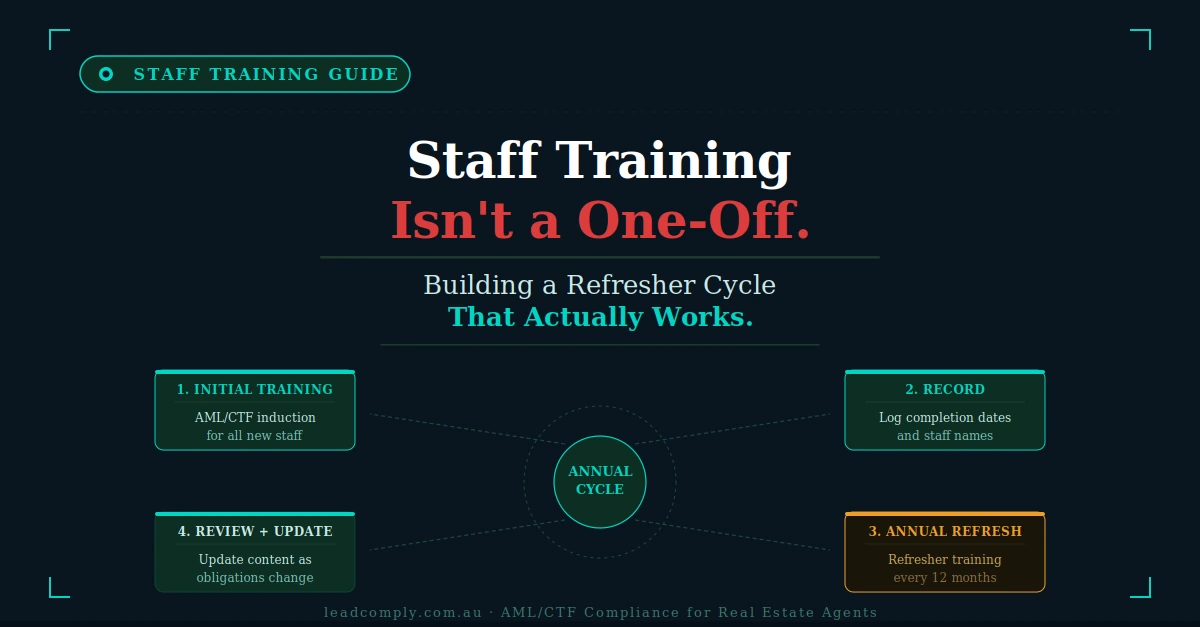
A lot of agencies treat AML/CTF training as something you do once, tick off, and move on from. Everyone sits through a session in the first week of the new obligations, it gets recorded somewhere, and that’s treated as the training obligation handled indefinitely. It isn’t. Staff turn over, memories fade, your business changes, and a training record from eighteen months ago tells an examiner almost nothing about what your current team actually knows today. Training needs to be a cycle, not an event.
Here’s what a genuine refresher cycle looks like, and why the gap between “we did training” and “we maintain training” matters more than it seems.
Why one-off training doesn’t hold up over time
Think about who was actually in the room the first time your agency ran AML/CTF training. If that was more than a few months ago, there’s a reasonable chance at least one person on your current team wasn’t there at all, because they joined afterward. There’s also a good chance the people who were there have forgotten specifics, because a single session, however thorough, doesn’t stay sharp in anyone’s memory for years without reinforcement.
On top of that, your business itself changes. If your risk assessment now identifies a customer segment or transaction type that wasn’t part of your original training content, staff are operating with a genuine knowledge gap, not because they weren’t trained, but because what they were trained on doesn’t match what they’re actually encountering now.
Two distinct training needs, not one
It helps to separate this into two genuinely different obligations, because they need different handling.
Onboarding training is for new staff, and it needs to happen before they’re handling transactions unsupervised, not months later at the next scheduled annual session. A new agent shouldn’t be three months into the job, already having handled dozens of customer interactions, before they’ve had any formal AML/CTF training at all.
Refresher training is for existing staff, delivered periodically to keep knowledge current and to cover anything that’s changed since the last session. This isn’t about repeating the same content word for word, it’s about reinforcing the fundamentals and specifically addressing whatever’s evolved in your risk profile or obligations since the previous round.
Treating these as one undifferentiated task is how gaps open up. A strong onboarding process with no refresher cycle leaves your longer serving staff running on increasingly stale knowledge. A strong refresher cycle with no proper onboarding process leaves new starters exposed during exactly the period they’re least equipped to notice something unusual.
What “evidenced” actually means
This is where a lot of otherwise reasonable training efforts fall down when it comes to actually proving they happened. A policy statement saying “all staff receive AML/CTF training” is not evidence. What you need, for every individual staff member, is a real name, a real date, what content was covered, and some form of confirmation they actually completed it, whether that’s a simple sign off, a short quiz, or a completion record from whatever system delivered the training.
If you can’t produce that specific record for a specific person on request, the training essentially didn’t happen from an evidentiary standpoint, however genuinely useful the session itself was. This isn’t bureaucracy for its own sake. It’s the only way to actually demonstrate the obligation was met, rather than assumed.
How often to actually refresh
An annual cycle is a reasonable baseline for most agencies, but treat it as a floor, not a ceiling. Certain events should trigger a refresher outside the normal schedule regardless of when the last one happened: a material update to your risk assessment, a genuine near miss or incident that revealed a gap in staff understanding, or a change in your AML/CTF obligations that affects how your team needs to operate. Waiting for the next scheduled annual session to address a gap you already know about is a choice to leave that gap open longer than necessary.
A worked comparison
One agency ran a single, thorough training session when the obligations first came into effect, and hasn’t revisited it since. Three staff members have joined since then and received only an informal handover from a colleague, not the actual training. When asked to demonstrate current training coverage, the agency can only point to a session from over a year ago that doesn’t include a third of their current team.
A second agency ran the same initial session, but built a simple annual refresher into their calendar, and added a rule that any new starter completes onboarding training before handling their first unsupervised transaction. When asked the same question, they can produce a complete, current record for every staff member, including exactly when each one was trained and on what.
Both agencies took AML/CTF training seriously at the outset. Only one of them still has anything to show for it now.
Keeping this low friction for a small agency
You don’t need an elaborate learning management system to run this properly. What actually matters is consistency, not sophistication.
Set a recurring calendar reminder for your annual refresher, and treat it as non negotiable, the same way you’d treat a licence renewal. Build training completion into your new starter checklist as a required step before they’re handling transactions alone, not an optional extra to get to when there’s time. Keep refreshers short and focused rather than repeating the full original session every time, a shorter, sharper update tends to actually get absorbed better than a long repeat of material people have already heard once.
Where Lead Comply fits into this
The Lead Comply AML Portal includes seven AML/CTF training modules for unlimited staff, at no cost, with no time limit on access. That means the same modules work for a new starter’s onboarding and for an existing team member’s periodic refresher, without needing to arrange or pay for anything separately each time your team changes. Completion is tracked against real names and dates, so when you need to demonstrate current training coverage, the record is already there rather than something you have to reconstruct.
