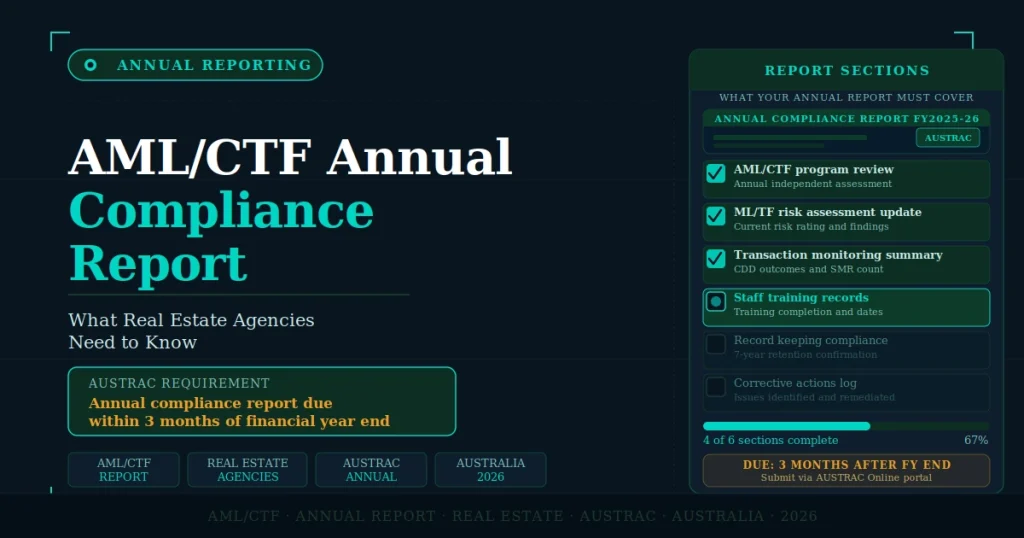
AML/CTF Annual Compliance Report: What Real Estate Agencies Need to Know
Every real estate agency enrolled with AUSTRAC as a Tranche 2 reporting entity is required to lodge an Annual Compliance Report. This is not optional, not waivable, and not a formality. It is a structured self-assessment of your compliance with every AML/CTF obligation — lodged directly with AUSTRAC, under your signature, once a year. What you report in this document shapes how AUSTRAC prioritises your agency for examination.
The Annual Compliance Report (ACR) is one of the nine AML/CTF obligations that apply to every Australian real estate agency from 1 July 2026. Most agencies understand the obligations that involve daily operations — collecting Customer Due Diligence, running PEP and sanctions screening, and lodging Suspicious Matter Reports. The ACR is different. It is an annual retrospective — a formal declaration to AUSTRAC that covers every aspect of the agency’s compliance performance across the reporting period.
Understanding the ACR before you have to lodge it is important for one specific reason: the questions the ACR asks are exactly the questions an AUSTRAC examination asks. An agency whose ACR reveals gaps — programs not in place, training not conducted, CDD not collected — has provided AUSTRAC with a roadmap of where to look. The ACR is simultaneously a compliance obligation and a supervision tool. Agencies that treat it as a box-ticking exercise will find it becomes something more consequential.
This guide explains what the ACR is, when it is due, what it asks, what AUSTRAC does with the information, and how real estate agencies should be preparing now to ensure their first ACR reflects genuine compliance.
| Key ACR facts for real estate agencies (Tranche 2 — from 1 July 2026): – Due date: 31 March each year, covering the previous calendar year (1 Jan – 31 Dec) – First ACR due; 31 March 2027, covering 1 July 2026 – 31 December 2026. How to lodge: AUSTRAC Online (online.austrac.gov.au) – Who must lodge: Every entity enrolled with AUSTRAC as a reporting entity. – Penalty for failure: Civil penalty provisions apply for late or non-lodgement. Source: AML/CTF Act 2006, Part 7 — Annual Compliance Reporting |
What Is the Annual Compliance Report?
The ACR is a mandatory annual self-assessment lodged through AUSTRAC Online. It requires reporting entities to answer a series of structured questions covering their compliance with AML/CTF obligations across the reporting year. The report covers the calendar year from 1 January to 31 December, and must be lodged by 31 March of the following year.
For real estate agencies commencing as reporting entities on 1 July 2026, the first ACR will cover the period from 1 July 2026 to 31 December 2026 — a partial year. The due date for this first ACR is 31 March 2027. Every subsequent ACR covers the full calendar year and is due on 31 March. The AUSTRAC enrolment process and the ACR obligation are connected: once your agency is enrolled, the ACR obligation begins immediately.
| 🎓 FROM LEAD COMPLY’S COMPLIANCE EXPERIENCE The ACR is often described as a compliance self-assessment — which is accurate but undersell sits significance. In more than six years of preparing and lodging ACRs in a heavily AUSTRAC-supervised industry, Lead Comply observed that the ACR is one of the primary tools AUSTRAC uses to prioritise its examination program. AUSTRAC does not have the capacity to examine every reporting entity every year. The ACR responses — particularly from newly regulated sectors — are analysed to identify entities that report low levels of SMR activity, incomplete training programs, or gaps in CDD collection. These responses inform the examination schedule. An agency that lodges an honest ACR reflecting partial compliance is not protected by its honesty. It is providing AUSTRAC with the information needed to prioritise it for examination. The only safe ACR is one that reflects genuine, documented compliance across every obligation area. |
When Is the Annual Compliance Report Due?
| ACR Cycle | Reporting Period | Due Date |
| First ACR — Tranche 2 real estate | 1 July 2026 (commencement) to 31 December 2026 | 31 March 2027 |
| Second ACR | 1 January 2027 to 31 December 2027 | 31 March 2028 |
| Third ACR and ongoing | 1 January to 31 December each year | 31 March the following year |
| ⚠️ THE FIRST ACR COVERS YOUR COMPLIANCE FROM DAY ONE The first ACR due on 31 March 2027 covers the period from 1 July 2026 to 31 December2026. AUSTRAC will ask whether you had a compliant AML/CTF program, trained staff, and conducted CDD from the commencement date — not from whenever you got around to it. An agency that did not have a compliant program in place from 1 July 2026 cannot lodge an honest ACR that says it did. The first ACR makes the compliance position from Day 1 a matter of formal record. |
What the Annual Compliance Report Asks
The ACR questions map directly to the nine AML/CTF obligations that apply to real estate agencies. The table below reflects the structure of the ACR as it applied to reporting entities in the periods prior to Tranche 2. The exact question set for Tranche 2 real estate agencies should be confirmed at austrac.gov.au when lodgement opens. The obligation areas covered are consistent across entity types.
| # | ACR Question Area | What It Is Assessing | Risk If You Cannot Answer Yes |
| 1 | AML/CTF Program | Whether the agency has a compliant, documented AML/CTF program covering Part A and Part B in place for the full reporting period | AUSTRAC examination likely — no program is the most serious ACR red flag |
| 2 | ML/TF Risk Assessment | Whether the agency has conducted a current ML/TF risk assessment covering its designated services, client types, and delivery channels | Triggers examination of risk methodology — risk assessment without substance is as problematic as no assessment |
| 3 | Staff Training | Whether all staff who provide designated services received AML/CTF training appropriate to their role, and whether records were kept | Training not conducted or not recorded is a consistent examination finding for newly regulated entities |
| 4 | Customer Due Diligence | Whether the agency applied CDD procedures to every customer in accordance with Part B of its AML/CTF program | Any CDD gap in the reporting period must be reported — agencies cannot aggregate or round up compliance |
| 5 | Ongoing Monitoring | Whether the agency monitored ongoing transactions and customer relationships for ML/TF risk throughout the reporting period | Absence of monitoring records suggests the program exists on paper only |
| 6 | Suspicious Matter Reporting | Whether the agency identified and lodged SMRs for all transactions or attempts that gave rise to a suspicion | Zero SMRs across a full reporting period from a real estate agency in a high-risk market will attract scrutiny |
| 7 | Record Keeping | Whether the agency maintained all required records for the required periods across all seven record categories | Record keeping failures are discovered at examination — the ACR triggers the examination that finds them |
| 8 | Independent Review | Whether the agency conducted an independent review of its AML/CTF program during the reporting period | Part A requires independent review — agencies that have not conducted one cannot honestly report compliance |
| 9 | Correspondent Banking (if applicable) | Whether the agency has any correspondent banking relationships requiring specific controls | Not applicable for most real estate agencies but must be addressed |
| 🎓 FROM LEAD COMPLY’S COMPLIANCE EXPERIENCE The ACR question that consistently reveals the most about an entity’s genuine compliance posture is the suspicious matter reporting question. Real estate is a high-risk sector for money laundering in the Australian context. Property transactions are a documented vehicle for value transfer, layering, and integration. AUSTRAC knows this. An agency operating in a high-value residential or commercial market that reports zero SMR activity across its first reporting period — no suspicious matters, no red flags, no escalations — is implicitly telling AUSTRAC one of two things: either its transaction monitoring is not functioning, or its staff training has not equipped agents to recognise red flags. Neither answer is comfortable for an examination. The Lead Comply AML/CTF platform maintains a complete SMR workflow record — every red flag identified, every decision made, every date recorded. When the ACR asks about SMR activity, agencies on the platform have a complete, auditable record to draw on. |
What AUSTRAC Does With the Annual Compliance Report
AUSTRAC uses ACR data for three purposes that directly affect real estate agencies as a newly regulated sector.
| How AUSTRAC Uses ACR Data | What This Means for Your Agency |
| Sector-level compliance monitoring | AUSTRAC aggregates ACR responses across the newly regulated real estate sector to assess overall compliance levels. Sector-wide gaps inform the resources AUSTRAC allocates to examining real estate entities in the following year. |
| Individual entity examination prioritisation | Specific ACR responses — particularly around program status, training coverage, and SMR activity — are used to prioritise individual entities for examination. An ACR that reveals compliance gaps effectively places the agency in the examination queue. |
| Regulatory intelligence | ACR data contributes to AUSTRAC’s broader intelligence picture of ML/TF activity in the property sector. Agencies that report consistent SMR activity with well-documented grounds contribute to that intelligence. Agencies that report nothing do not. |
For real estate agencies, the ACR’s role in examination prioritisation is the most immediately consequential. Lead Comply’s full guide to what AUSTRAC examination involves — including what examiners look for, how they assess records, and what preliminary findings typically cover — is available at: AUSTRAC Examination Process: What Happens When AUSTRAC Audits Your Agency.
How to Prepare for the ACR Now
The preparation for a compliant ACR begins on 1 July 2026 — not in February 2027 when lodgement is approaching. Every obligation area the ACR asks about must be documented from commencement, because the ACR asks about the full reporting period. These are the six preparation priorities.
| Priority 1 — Have Your AML/CTF Program Formally Adopted Before You Transact; The ACR asks whether your AML/CTF Program was in place for the reporting period. A program adopted in October 2026 for a reporting period that began in July 2026 cannot honestly be reported as covering the full period. The complete program documentation — Part A, Part B, risk assessment, and all associated procedures — must be formally adopted by the principal before the first designated service is provided. Priority 2 — Conduct and Document the ML/TF Risk Assessment: The ML/TF Risk Assessment must be conducted before the program is adopted and must reflect the agency’s specific client base, designated services, and geographic market. A generic risk assessment that rates all risk dimensions as low without substantive analysis will not satisfy AUSTRAC — and will not produce an honest ACR response. Priority 3 — Train All Staff Before They Provide Designated Services; The ACR asks about staff training coverage and record keeping. Every staff member who provides designated services must receive AML/CTF training before they commence, and the training record must document the content, the date, and the method of delivery. The Lead Comply AML/CTF platform generates this record automatically. Priority 4 — Collect CDD on Every Customer from Day One: The ACR asks about CDD compliance across the reporting period. Any transaction where required CDD was not collected is a gap in the ACR record. The collection must be systematic and documented — not retrospective. The Lead Comply AML Portal enforces CDD collection through guided digital forms for every client type. Priority 5 — Maintain a Complete Record of All SMR Decisions; The ACR asks about suspicious matter reporting — not just SMRs lodged, but the agency’s monitoring process and decision-making. Every red flag considered, every decision about whether to lodge, and every date must be documented. The absence of any SMR record is not the same as having no suspicious matters — it may mean the monitoring process is not functioning. Priority 6 — Keep All Required Records from Commencement: The ACR asks about record keeping across all seven required record categories for the full reporting period. Records that are created retrospectively — assembled before lodgement rather than maintained throughout the year — are not compliant. The Lead Comply AML/CTF platform maintains records continuously from the first client interaction. |
The Independent Review Requirement
The ACR asks whether the agency conducted an independent review of its AML/CTF program during the reporting period. This requirement comes from AML/CTF Program Part A — which requires every reporting entity to have its AML/CTF program independently reviewed at regular intervals.
For newly enrolled real estate agencies, the timing of the first independent review is an important planning consideration. AUSTRAC’s expectation is that the review is conducted within a reasonable time after commencement — typically within the first 12 to 18 months. For the first ACR (covering July to December 2026), an agency that commenced in July 2026 may not yet have completed an independent review by the lodgement date of 31 March 2027 — but should have one scheduled.
Lead Comply conducts independent program reviews as a standalone service for agencies that have their own program in place, and as part of the ongoing compliance support included in the complete package.
| 📋 WHAT GOES WRONG IN PRACTICE — WHAT LEAD COMPLY SEES Three ACR preparation failures Lead Comply anticipates for newly regulated real estate entities: 1 — The agency treats the ACR as an end-of-year task. The ACR asks about compliance across the full reporting period. Agencies that begin collecting records and documenting compliance in February 2027 — six weeks before the lodgement deadline — will find they cannot honestly report compliance for the period July to December 2026. The ACR is not prepared in March. It is prepared continuously from 1 July 2026. 2 — The agency reports zero suspicious matter activity without examining why. A real estate agency in an active residential or commercial market that had no suspicious clients, no unusual payment patterns, no offshore structures, and no red flags across a six-month period is either remarkably fortunate or not looking. AUSTRAC’s examination program in the real estate sector specifically targets this pattern. Zero SMRs should prompt an internal review of whether the monitoring process is functioning, not a simple “nil” response on the ACR. 3 — The agency lodges an inaccurate ACR to avoid disclosure of gaps. An ACR that misrepresents the agency’s compliance position is significantly more serious than one that honestly discloses gaps. AUSTRAC examiners cross-reference ACR responses against operational records during examination. An ACR that says training was conducted when it was not, or that CDD was collected when records do not support that claim, transforms a compliance gap into a false declaration. |
| ✓ WHAT AN ACR-READY REAL ESTATE AGENCY LOOKS LIKE ON 31 MARCH 2027 – Compliant AML/CTF Program formally adopted before 1 July 2026 — Part A and Part B both in place. – ML/TF Risk Assessment completed and documented before commencement. – All staff trained before providing designated services — training records maintained throughout the period. – CDD collected and documented for every client throughout July to December 2026. – SMR decisions recorded — every red flag considered, every lodgement decision documented with date and grounds. – Seven-category records maintained continuously from commencement· Independent program review scheduled or completed within the first 12 to 18 months. – Lead Comply ongoing support in place — examination readiness maintained throughout the year |
| Frequently asked questions on the AUSTRAC Annual Compliance Report: What happens if we miss the ACR lodgement deadline? — Civil penalty provisions apply under the AML/CTF Act 2006. AUSTRAC has the power to impose penalties for late or non-lodgement. Late lodgement also signals to AUSTRAC that the entity’s compliance management is insufficient. What if our ACR reveals gaps in our compliance? — Honest disclosure of compliance gaps is preferable to an inaccurate ACR. However, disclosing gaps in the ACR increases examination risk. The most effective approach is to have no gaps to disclose — which means genuine compliance from Day 1. Do we need a lawyer to lodge the ACR? — No. The ACR is lodged through AUSTRAC Online by the compliance officer or principal. Lead Comply can support agencies in preparing their ACR responses and reviewing the self-assessment before lodgement. What is an independent review and who can conduct it? — An independent review assesses whether the AML/CTF program remains appropriate, adequate, and effective. It must be conducted by someone independent of the program — typically an external compliance consultant such as Lead Comply. |
Book a free 30-minute Clarity Call with Lead Comply. In 30 minutes you will know exactly which ACR question areas your current compliance position supports — and what needs to change before the reporting period closes on 31 December 2026.
