AML CTF compliance real estate agents
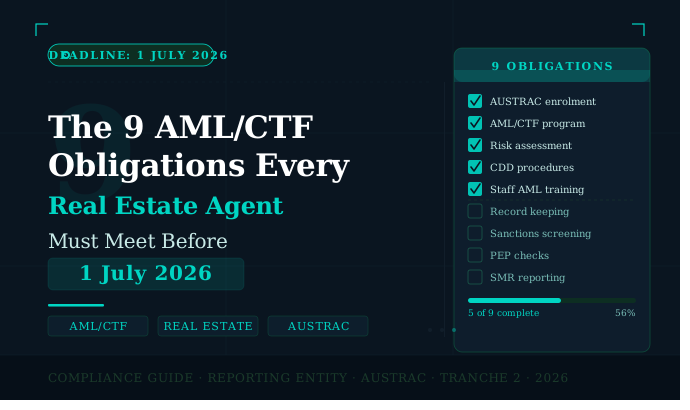
From 1 July 2026, Australian real estate agents are AML/CTF reporting entities under the law. That means nine specific obligations — each one mandatory, each one enforceable. Here is exactly what they are, what they require in practice, and what happens if they are not met.
AUSTRAC Tranche 2 has closed the gap that has existed in Australia’s anti-money laundering framework since 2006. Real estate has long been identified as a high-risk channel for money laundering in Australia — property transactions are large, often complex, and have historically lacked the oversight that banks and financial institutions operate under.
That changes from 1 July 2026. Every real estate agency that sells, purchases, or auctions property on behalf of another person is now a reporting entity under the Anti-Money Laundering and Counter-Terrorism Financing Act 2006. That status comes with nine core obligations — all of which must be met.
This guide covers each obligation in plain English. It tells you what is required, why it exists, and what a compliant response looks like for a real estate agency.
| ⚠️ PENALTY REMINDER Non-compliance with AML/CTF obligations carries penalties of up to AUD $2.22 million per breach forbusinesses and up to AUD $6.6 million for individuals. There is no minimum size exemption.A sole-principal agency has the same obligations as a multi-office operation. |
The 9 Obligations — What You Must Do
The obligations are not optional add-ons or best-practice recommendations. They are legal requirements under the AML/CTF Act. Here is each one:
| 1 | AUSTRAC Enrolment⏰ Deadline: 29 July 2026 — failure to enrol is itself a breach Every reporting entity must enrol on the AUSTRAC Reporting Entity Roll. The enrolment portal opened on 31 March 2026. Enrolment requires you to register your business details, your principal officer, your compliance officer, and your designated services. Enrolment does not mean your program is approved — it means AUSTRAC knows you exist as a reporting entity. What happens after enrolment is equally important. |
| 2 | AML/CTF Program Part A — Governance Framework Part A is your governance document. It sets out who in your organisation is responsible for AML/CTF compliance, what your risk appetite is, how your compliance function operates, and what controls you have in place to manage money laundering and terrorism financing risk. This is not a template document. AUSTRAC expects your Part A to reflect your actual business — your structure, your oversight mechanisms, and your genuine commitment to compliance. A program that reads like every other agency’s program is a liability. |
| 3 | AML/CTF Program Part B — Customer Identification Procedures Part B sets out the step-by-step procedures your agency follows to identify and verify every client before providing any designated service. The obligation is to identify the customer, verify their identity using reliable and independent sources, and identify the beneficial owner where applicable. For real estate agencies, the designated service is selling, purchasing, or auctioning property on behalf of another person. Part B procedures apply before you act for any client — before you list, before you engage buyers, before you bid at auction. |
| 4 | ML/TF Risk Assessment Before you can design your AML/CTF program properly, you must conduct a formal Money Laundering and Terrorism Financing Risk Assessment of your business. This assessment covers four dimensions: your customer types, your designated services, your delivery channels, and your geographic exposure. The risk assessment is not a one-time exercise. AUSTRAC expects it to be reviewed when your business changes, when new regulatory guidance is issued, and at a minimum annually. |
| 5 | Customer Due Diligence (CDD) CDD is the practical application of your Part B procedures. Before providing any designated service, you must collect and verify the identity of your client. CDD is an ongoing obligation — not just at onboarding. If your client’s circumstances change, your CDD must be updated. Standard CDD applies to most clients. Enhanced Due Diligence (EDD) applies when risk factors are present — including clients who are Politically Exposed Persons (PEPs), transactions that are unusually complex or large, or clients in high-risk jurisdictions. |
| 6 | Sanctions and PEP Screening Before acting for any client, you must screen them against applicable sanctions lists — including the Australian Consolidated Sanctions List maintained by the Department of Foreign Affairs and Trade (DFAT) — and against Politically Exposed Persons registers. A Politically Exposed Person is someone who holds or has held a prominent public position — a foreign government minister, a senior military official, an executive of a state-owned company. PEPs represent elevated risk and require Enhanced Due Diligence. |
| 7 | Suspicious Matter Reporting (SMR)⏰ Terrorism financing: report within 24 hours · Other suspicious matters: report within 3 business days If you form a suspicion that a client or transaction may involve money laundering, terrorism financing, tax evasion, or other serious crime — you must report that suspicion to AUSTRAC by lodging a Suspicious Matter Report. The obligation to report arises the moment you form the suspicion, even if the transaction does not proceed. Suspicion is a lower threshold than certainty. You do not need proof. You do not need to investigate. You need a genuine, reasonable basis to suspect that something is not right. |
| 8 | Record Keeping⏰ Minimum 7 years — from the date of the transaction or the last CDD action You must keep records of all customer identification information, all CDD actions, all transactions, and all AML/CTF program documents for a minimum of seven years. These records must be accessible to AUSTRAC on request. Record keeping is the evidence of compliance. In an AUSTRAC audit or examination, your records are how you demonstrate that you have met your obligations. A compliant program that cannot be evidenced by records is not a compliant program in practice. |
| 9 | Staff Training Every person in your agency who is involved in providing designated services must receive AML/CTF training — and that training must be documented and acknowledged in writing. Training must cover the nature of money laundering and terrorism financing risk, your agency’s obligations, and the red flags relevant to real estate transactions. Training is not a one-time event. It must be refreshed when your program is updated, when new staff join, and at a minimum annually. New staff must be trained before they begin providing designated services. |
All 9 Obligations at a Glance
| # | Obligation | Key Action Required | Deadline / Frequency |
| 1 | AUSTRAC Enrolment | Register on the Reporting Entity Roll | 29 July 2026 — one time |
| 2 | AML/CTF Program Part A | Document governance, controls and risk appetite | Before 1 July 2026 — annual review |
| 3 | AML/CTF Program Part B | Document client identification procedures | Before 1 July 2026 — annual review |
| 4 | ML/TF Risk Assessment | Assess customer, service, channel and geography risk | Before 1 July 2026 — annual review |
| 5 | Customer Due Diligence | Identify and verify every client before service | Before each designated service |
| 6 | Sanctions and PEP Screening | Screen clients against DFAT and PEP registers | Before each designated service — ongoing |
| 7 | Suspicious Matter Reporting | Report suspicions to AUSTRAC promptly | 24 hours (terrorism) / 3 days (other) |
| 8 | Record Keeping | Retain all CDD and transaction records | 7 years — from date of transaction |
| 9 | Staff Training | Train all staff involved in designated services | Before commencement — annual refresh |
The Most Common Compliance Mistakes Real Estate Agents Make
Based on the AML/CTF programs Lead Comply has reviewed and designed, these are the gaps that appear most frequently in agencies trying to self-implement or use software-generated templates:
| Common Mistake | Why It Is a Problem |
| Using a generic AML template | AUSTRAC expects programs tailored to your business. A generic program that could apply to any agency does not demonstrate genuine compliance. |
| CDD after the transaction begins | The obligation is to complete CDD before providing the designated service. Starting CDD partway through a transaction is a breach. |
| No documented risk assessment | Without a documented risk assessment, there is no basis for your program design. AUSTRAC will look for this in any examination. |
| Training with no records | Training that is not documented did not happen from a compliance perspective. Verbal briefings are not sufficient. |
| Missing beneficial owner identification | For corporate, trust, and SMSF clients, identifying the beneficial owner is mandatory — not optional. Many agencies miss this step. |
| Not updating the program | A program designed in 2026 that is never reviewed is not compliant by 2027. Annual review is a core obligation. |
How Lead Comply Helps Real Estate Agencies Meet All 9 Obligations
Lead Comply designs AML/CTF programs specifically for Australian real estate agencies. Every engagement starts with a structured gap assessment of your actual business — your designated services, your client types, your team structure, and your existing controls.
What is delivered in a standard Lead Comply engagement:
- Documented ML/TF Risk Assessment covering all four AUSTRAC dimensions
- AML/CTF Program Part A — governance framework, tailored to your agency
- AML/CTF Program Part B — step-by-step client identification and verification procedures
- CDD forms, sanctions screening procedures, and suspicious matter reporting protocols
- Staff training — delivered, completed, and documented
- AUSTRAC enrolment support
- Ongoing advisory access for suspicious matter questions
Every program is delivered personally by Danny Huynh — a BSI-certified Lead Internal Auditor with experience in management systems compliance and AML/CTF program design. Not software. Not templates. A consultant who understands your business.
Where are you in your compliance journey?
Not started → Book a free Clarity Call this week. The 29 July 2026 AUSTRAC enrolment deadline is closer than it looks.Partially started → Request a gap assessment. Know exactly what is missing before the deadline.Used AML software → Have your program reviewed. Software-generated programs carry significant risks.
