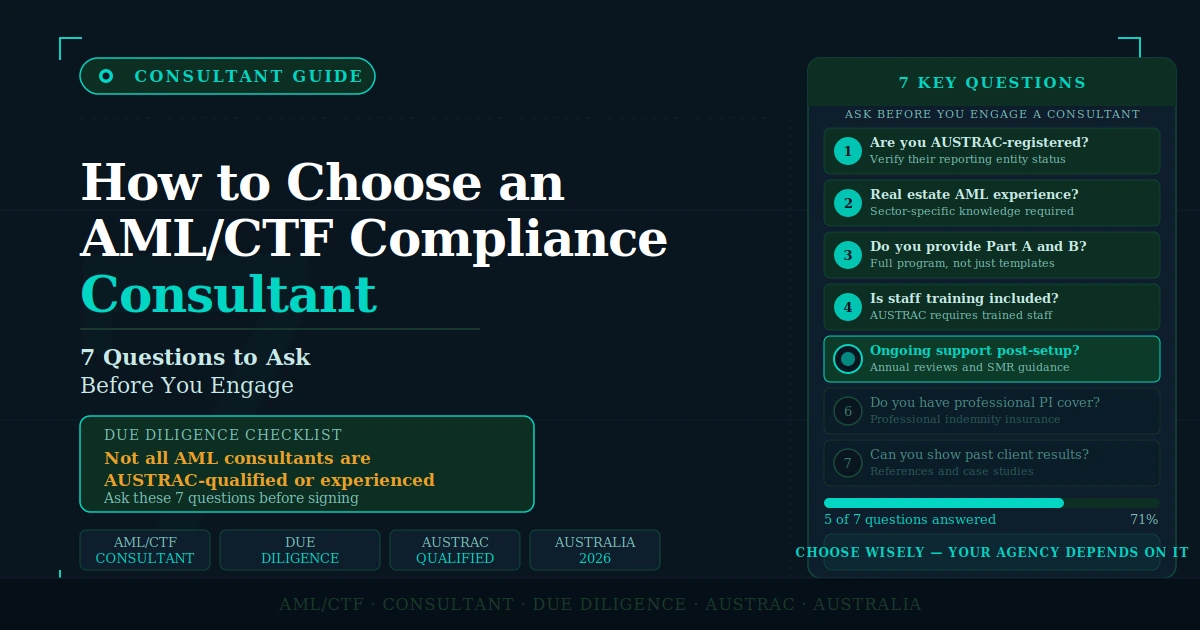
How to Choose an AML/CTF Compliance Consultant: 7 Questions to Ask Before You Engage
With 1 July 2026 approaching, the market for AML/CTF compliance consultants serving real estate agents has grown rapidly. Not every consultant offering compliance services has the depth of experience to deliver a program that genuinely protects your agency. These seven questions separate the consultants who can from those who cannot.
Every real estate agency principal in Australia is making the same decision right now: do we build our AML/CTF compliance program internally, or do we engage a consultant? Most are choosing to engage — which is the right decision. The nine obligations under the AML/CTF Act 2006 are complex, interrelated, and carry serious penalties for non-compliance. The risk of getting them wrong without professional support is real.
The problem is not the decision to engage a consultant. The problem is choosing the wrong one. In the months leading up to 1 July 2026, the compliance consulting market has filled with providers offering AML/CTF services — some with deep regulated-industry experience, some with general consulting backgrounds who have pivoted to the new market, and some who are essentially reselling generic templates. The quality difference between these providers is significant. The consequences of choosing the wrong one are potentially severe.
This article gives you seven specific, direct questions to ask any AML/CTF compliance consultant before you engage — and tells you exactly what genuine answers look like versus what red flags sound like. For context on what your compliance program must deliver, see Lead Comply’s full guide to the nine AML/CTF obligations applicable to real estate agents.
| Why these questions matter more than credentials alone: AML/CTF compliance is a regulated industry discipline. The question is not whether a consultant has a compliance background — it is whether they have operated an AML/CTF program in a supervised environment, understand what AUSTRAC examinations actually look for, and can design a program that works operationally, not just on paper. Generic compliance backgrounds, legal training, and general consulting experience are not substitutes for direct AML/CTF program management experience under AUSTRAC supervision. These seven questions help you tell the difference. |
| Question 1: Have you personally managed an AML/CTF compliance program in a regulated Australian industry? Why this question matters: The most important differentiator between genuine AML/CTF expertise and theoretical knowledge is whether the consultant has actually operated a compliance program under AUSTRAC supervision — not just advised on one. Managing a program means designing it, implementing it, maintaining it through regulatory changes, training staff on it, and defending it during examination. What to listen for: A consultant with genuine experience will name the regulated industry, describe their specific role, and be able to explain what they learned from operating the program in practice. Vague answers about “extensive compliance experience” or “working with AUSTRAC-regulated entities” without specifics are a red flag. Lead Comply’s answer: More than six years of direct AML/CTF program management in the Australian gaming manufacturing industry — one of the most heavily AUSTRAC-supervised sectors in the country. This is the operational foundation of every compliance program Lead Comply designs. |
| Question 2: Do you specialise in real estate, or do you serve multiple sectors with the same program? Why this question matters: AML/CTF compliance is not sector-agnostic. The designated services that apply to real estate agents, the risk indicators specific to property transactions, the ownership structures common in your market, and the client types your agency serves all require expertise specific to real estate. A consultant who delivers the same program to accountants, lawyers, and real estate agents is almost certainly working from a generic template. What to listen for: A specialist will be able to describe the specific money laundering risks in real estate transactions — large cash deposits, offshore purchasers, complex trust and corporate structures, rapid resale patterns, and high-value property as a vehicle for value transfer. A generalist will describe AML/CTF compliance in abstract terms. Lead Comply’s answer: Lead Comply’s AML/CTF practice is built specifically for real estate agencies and Australian SMEs under Tranche 2. Every program, every procedure, every risk assessment reflects the specific obligations and risk profile of the real estate sector — not a multi-sector template. |
| 🎓 FROM LEAD COMPLY’S COMPLIANCE EXPERIENCE The distinction between sector-specific and generic compliance programs is most visible in the procedures. A genuine real estate AML/CTF program contains specific identification and verification procedures for the company and trust structures that are common in investment property markets — discretionary trusts with corporate trustees, SMSFs purchasing through barefoot trustee arrangements, offshore holding companies with Australian nominees. A generic program addresses these structures with placeholder language that the agent cannot follow in practice. The gap only becomes apparent when the agent encounters the client type the procedure was not designed for — and then either collects inadequate CDD or stops the transaction unnecessarily. |
| Question 3: What does your compliance program actually include — and can I see the structure before I engage? Why this question matters: A compliance program for real estate agencies must cover all nine obligations in substantive detail. Some consultants deliver a document that looks complete — correct headings, appropriate language — but contains insufficient content under each heading to satisfy AUSTRAC. Others deliver a template with the agency’s name inserted. The only way to assess quality before engaging is to ask to see the program structure. What to listen for: A confident, experienced consultant will show you the structure of a completed program (not a client’s confidential program — the framework). They will be able to describe exactly what Part A covers, what Part B covers for each client type, and how the risk assessment connects to the program controls. Reluctance to describe the program in detail before engagement is a red flag. Lead Comply’s answer: Lead Comply’s complete program includes a customised ML/TF Risk Assessment, full Part A governance framework, Part B procedures for all four client types (individual, company, trust, SMSF), PEP and sanctions screening procedure, SMR escalation procedure, staff training framework, and record keeping framework. The free demo shows the program and the platform together. |
| Question 4: Do you provide technology to operationalise the program, or do you leave implementation to us? Why this question matters: A compliance program document is necessary but not sufficient. The gap between having a program and actually being compliant is the operationalisation gap — the difference between what the document says and what agents do in every client transaction. Most consultants deliver a program document and leave the agency to implement it using their existing CRM or paper-based processes. This consistently produces the same outcome: CDD is collected inconsistently, clients are not screened, and training records are incomplete. What to listen for: A consultant who understands operational compliance will have a view on how the program is embedded into daily workflow — whether through a dedicated platform, a configured CRM, or structured manual processes. A consultant who has not considered this question is delivering a document, not a compliance solution. Lead Comply’s answer: Lead Comply delivers both the Compliance Program Manual and the Lead Comply AML/CTF platform — nine compliance modules purpose-built for AUSTRAC Tranche 2 obligations. Client CDD forms, beneficial owner workflows, PEP and sanctions screening, SMR workflow, staff training delivery, compliance dashboard, and seven-year record keeping are all built into the platform. The program and the platform are designed to work together. |
| Question 5: What does your staff training cover, and how is it delivered and recorded? Why this question matters: Staff training is one of the nine obligations and one of the most commonly inadequate components in self-implemented or generically consulted programs. AUSTRAC requires training to be tailored to your agency’s designated services and risk profile, delivered before staff commence providing designated services, and documented with sufficient detail to satisfy an examination — content, delivery method, dates, and evidence of comprehension. What to listen for: A genuine AML/CTF training program will describe specific content areas relevant to real estate: the tipping off prohibition, beneficial owner identification, red flags specific to property transactions, and the SMR escalation path. A consultant offering a “compliance awareness module” or a “one-hour online course” without sector-specific content is not meeting the standard. Lead Comply’s answer: Lead Comply’s staff training is delivered through the AML/CTF platform as role-appropriate modules for principals, compliance officers, and front-line agents. Completion is recorded automatically, the training register is generated by the platform, and the content is specific to real estate transactions and the nine AUSTRAC obligations. |
| 🎓 FROM LEAD COMPLY’S COMPLIANCE EXPERIENCE The two training areas that most consistently reveal whether a consultant genuinely understands AML/CTF compliance for real estate are the tipping off prohibition and beneficial owner identification for non-individual clients. The tipping off prohibition is not intuitively obvious to agents who are relationship-focused. The concept that you cannot disclose to a client that you have compliance concerns about their transaction requires specific, scenario-based training — not a checkbox on a general awareness module. A consultant who does not specifically cover tipping off in their training program has not designed training that meets the AUSTRAC standard for real estate. For more on the training obligation, see Lead Comply’s full guide: . |
| Question 6: Do you support us through an AUSTRAC examination — or does your engagement end at program delivery? Why this question matters: Delivering a compliant program is the beginning of the compliance relationship, not the end. AUSTRAC’s examination program for Tranche 2 real estate entities will begin in the 12 to 24 months following 1 July 2026. An agency whose consultant has moved on by then is on its own during the most consequential compliance event it will face. Examination support — including responding to preliminary findings, preparing staff for examiner interviews, and organising records for production — requires a consultant who knows your program intimately. What to listen for: A consultant who describes their service as “program delivery” and has no examination support offering has not designed their service for the full compliance journey. Ask specifically: what happens if we receive an AUSTRAC examination notice? A consultant who cannot answer that question in specific terms has not thought through it. Lead Comply’s answer: Lead Comply’s ongoing compliance support covers the full journey — from program delivery through staff training, annual program review, and examination support. The Lead Comply AML/CTF platform maintains your examination-ready records continuously. For more on what AUSTRAC examinations involve, see: [object Object]. |
| Question 7: What is included in your price — and is there a fixed-price option before 1 July 2026? Why this question matters: Pricing transparency is a signal of service clarity. A consultant who cannot describe specifically what is included in their price — which deliverables, how many revisions, whether training is included, whether examination support is covered — has not designed a service with a clear scope. Variable pricing that depends on “complexity assessed after engagement” creates cost uncertainty at the most pressure-filled point in the compliance calendar. What to listen for: Ask for a written scope of what is included before you sign anything. A reputable consultant will provide a clear deliverables list. A fixed-price option for a defined package is the clearest signal that the consultant has a well-defined, repeatable service — not a custom engagement built around the maximum billable hours the deadline will support. Lead Comply’s answer: Lead Comply offers the Complete AML/CTF Package at a fixed price for a limited time before 1 July 2026. The package includes the Compliance Program Manual, the AML/CTF platform, staff training, onboarding support, and ongoing compliance consulting. Everything is defined upfront. See the full package: [object Object]. |
The Red Flags to Watch For
Beyond the seven questions, the following responses from any AML/CTF consultant should prompt you to look further before engaging.
| Red Flag | What It Usually Means |
| “We use a proven template that we adapt for each client” | The program is a template with the agency’s name inserted. Templates that are not genuinely redesigned from the ground up cannot satisfy the AUSTRAC requirement that Part B procedures reflect the agency’s specific client base and risk profile. |
| “Our program has been used by many real estate agencies” | Reusing the same program across multiple agencies is not the same as customising it. AUSTRAC examines whether the program reflects the specific agency — not whether it has been used elsewhere. |
| “We have extensive compliance experience across multiple regulated industries” | General compliance experience is not a substitute for specific AML/CTF program management experience under AUSTRAC supervision. Ask which regulated industries and what specifically they managed. |
| “The training is a one-hour online module with a certificate” | AML/CTF training for real estate must be tailored to the agency’s designated services. A generic online module that applies to any sector does not meet the AUSTRAC standard for real estate. |
| “We will sort out the examination if it comes up” | Examination support requires deep familiarity with the program. A consultant who treats examination support as a future contingency rather than a defined service offering has not prepared for it. |
| “You will not need to worry about AUSTRAC for a while yet” | AUSTRAC has publicly stated that real estate is a priority supervision sector. Any consultant who suggests examination risk is low for a newly regulated real estate agency is not giving you accurate guidance. |
Why Lead Comply
Lead Comply was built to answer every one of these seven questions directly. More than six years of direct AML/CTF program management in a heavily supervised Australian industry. Sector-specific expertise in real estate compliance. A complete program that covers all nine obligations with substantive, tailored content. A purpose-built AML/CTF platform that operationalises the program into daily workflow. Staff training delivered and recorded through the platform. Examination support built into the ongoing service. Fixed-price package transparency before 1 July 2026.
The free 30-minute Clarity Call is where the seven questions above get answered for your specific agency — including a live demonstration of the Lead Comply AML/CTF platform, a walkthrough of the Compliance Program Manual structure, and a same-session quote on the fixed-price complete package.
| 📋 WHAT GOES WRONG IN PRACTICE — WHAT LEAD COMPLY SEES Three consultant selection mistakes Lead Comply encounters when agencies come for a second opinion: 1 — The agency engaged a general compliance consultant who delivered a program document but no implementation support. By the time the agency contacted Lead Comply, agents had been conducting transactions for weeks without collecting CDD, the training register was empty, and the SMR escalation path had never been communicated to front-line staff. The program existed. The compliance did not. Rebuilding costs more than getting it right the first time. 2 — The agency bought a generic AML/CTF template online and is presenting it as their program. The template has the right headings. The content under those headings does not reflect the agency’s actual operations, client types, or risk profile. When an AUSTRAC examiner asks a front-line agent to describe the CDD process for a trust client, the agent cannot — because the procedure was never designed for their specific workflow. 3 — The agency engaged a consultant who completed the program but has since moved on. The agency receives an AUSTRAC examination notice and has no compliance support. The program exists but the consultant relationship has ended. Examination preparation without someone who knows the program intimately is a significantly more difficult and costly process than having a consultant who has been with you throughout. |
| ✓ WHAT A WELL-CHOSEN AML/CTF COMPLIANCE CONSULTANT DELIVERS – Direct AML/CTF program management experience in a regulated Australian industry under AUSTRAC supervision. – Sector-specific expertise in real estate — designated services, ownership structures, and transaction risk. – A complete, substantive program: Part A, Part B, Risk Assessment, CDD, SMR, Training, Record Keeping. – Technology to operationalise the program into daily workflow — not just a document. – Staff training delivered, recorded, and examination-ready from Day 1. – AUSTRAC examination support built into the ongoing service relationship. – Transparent fixed-price scope before 1 July 2026. – A consultant who is still there when the examination notice arrives. |
| Frequently asked questions on choosing an AML/CTF consultant: How do I know if a consultant’s program will satisfy AUSTRAC? — Ask to see the structure before engaging. A program that cannot be described in specific terms for your sector before you pay for it is unlikely to be specific enough after you do. Should we use our industry association’s template instead of a consultant? — A template can be a useful reference. It is not a compliant AML/CTF program. The Part B procedures, risk assessment, and training program must be designed for your specific agency. See Lead Comply’s guide: AML/CTF Program Part B. How much should AML/CTF compliance consulting cost? — Cost varies by scope. The right question is not what it costs but what is included. A low-cost template is not cheaper than a complete program if it results in an AUSTRAC examination finding and the cost of remediation. What if we are already enrolled but have no program? — Contact Lead Comply now. The deadline is 1 July 2026. A fixed-price complete package can be delivered and implemented before commencement for agencies that act immediately. |
Book a free 30-minute Clarity Call. See the Compliance Program Manual structure, the Lead Comply AML/CTF platform in action, and receive a same-session quote on the fixed-price complete package — before 1 July 2026.
