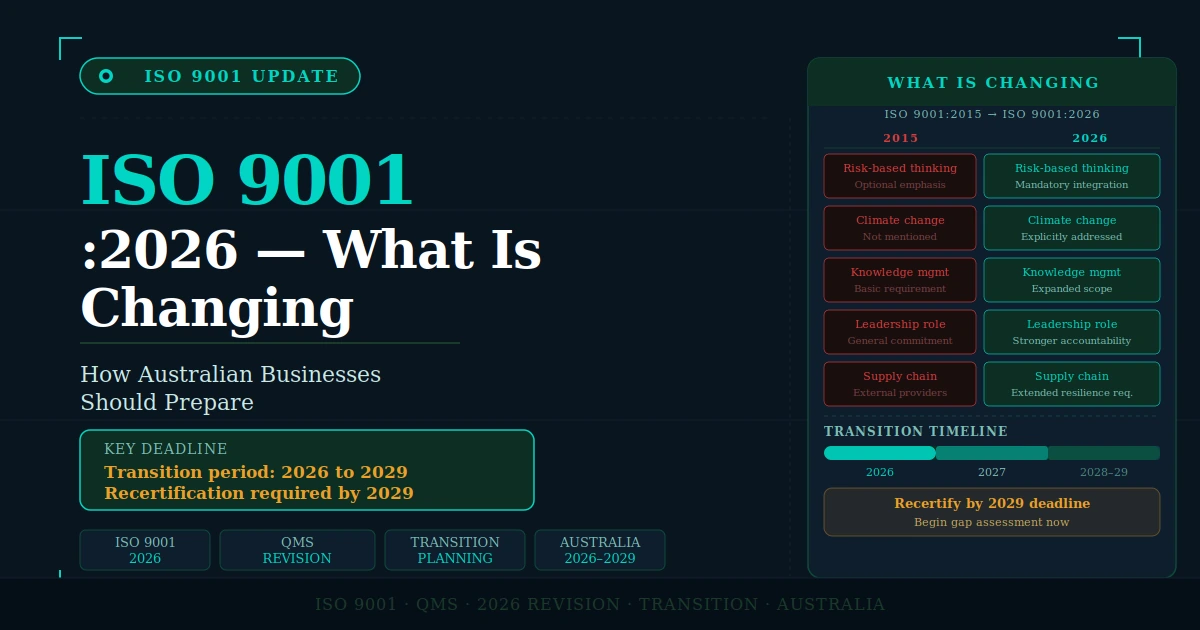
ISO 9001:2026 — What Is Changing and How Australian Businesses Should Prepare
ISO 9001:2015 has served as the global standard for Quality Management Systems for over a decade. A revision is now in progress, with ISO 9001:2026 anticipated as the next iteration. For Australian businesses that are certified, pursuing certification, or maintaining a QMS, understanding what is expected to change — and what is not — is the foundation of a sound transition plan.
ISO 9001 is the world’s most widely adopted management system standard. More than one million organisations in over 170 countries hold ISO 9001 certification. In Australia, it is a requirement for government supplier panels, a tender prerequisite across multiple industries, and a quality signal that professional services firms, manufacturers, and SMEs use to differentiate themselves in competitive markets.
ISO standards are subject to periodic review. The requirement under ISO procedures is that every standard is reviewed at least every five years to assess whether it remains current and fit for purpose. ISO 9001:2015 was subject to systematic review, and the decision was made to revise the standard. The revision is being developed by ISO Technical Committee 176 (ISO/TC 176), which is responsible for quality management standards. The expected outcome is ISO 9001:2026.
This article explains what the revision involves, which clauses are expected to change, what the transition timeline looks like for Australian businesses, and what steps Lead Comply recommends taking now. For the most current status of the ISO 9001 revision, businesses should consult iso.org, bsigroup.com/en-AU, and standards.org.au.
| Important note on timing: This article is written in June 2026. ISO 9001:2026 is anticipated but may not yet be formally published at the time you are reading this. The anticipated changes described here are based on ISO’s published revision communications, the 2024 amendment to ISO 9001:2015, and developments tracked through ISO/TC 176 working group publications. The final published standard may differ in specific requirements. Businesses should verify current status at iso.org and confirm transition timelines with their certification body. What will not change: the ISO 9001 transition principle. When a new version is published, certified organisations are given a defined transition period — typically three years — to update their QMS to the new requirements. |
Why Is ISO 9001 Being Revised?
ISO 9001:2015 introduced significant structural changes from the previous version — most notably the adoption of the High Level Structure (HLS) common to all ISO management system standards, a stronger emphasis on risk-based thinking, and the removal of prescriptive requirements for a quality manual and documented procedures.
The systematic review of ISO 9001:2015 identified areas where the standard needed to evolve to reflect changes in the operating environment since 2015. Key drivers of the revision include:
- The emergence of sustainability and climate change as material business considerations that quality management cannot ignore
- The accelerated shift to digital operations, remote working, and technology-dependent service delivery since 2020
- The need to align with updates to the ISO Annex SL framework, which provides the common structure for all management system standards
- Feedback from certification bodies, auditors, and organisations worldwide that certain clauses needed clarification or strengthening
- The 2024 amendment to ISO 9001:2015, which introduced climate change language as a preliminary step ahead of the full revision
| 🎓 FROM LEAD COMPLY’S COMPLIANCE EXPERIENCE The 2024 amendment to ISO 9001:2015 (ISO 9001:2015/Amd 1:2024) is significant because it gives Australian businesses a preview of the direction of the full revision. The amendment added two sentences to Clauses 4.1 and 4.2, requiring organisations to consider whether climate change is a relevant external issue and whether relevant interested parties have requirements related to climate change. For many Australian SMEs, this seems abstract. In practice it means: does your business face material risks or opportunities from climate change — through regulation, supply chain disruption, physical risk, or stakeholder expectations — and if so, how does that affect your QMS? For businesses in construction, agriculture, food production, and logistics, the answer is almost certainly yes. Organisations that have already addressed the 2024 amendment are ahead of the revision curve. Those that have not should start there. |
The Key Changes Expected in ISO 9001:2026
Based on ISO/TC 176 working group communications and the pattern established by the 2024 amendment, the following areas are expected to change in ISO 9001:2026. These are anticipated changes, not confirmed requirements. The final standard will be authoritative.
| Clause Area | What Is Expected to Change | Practical Impact for Australian SMEs |
| Clause 4.1 and 4.2Context and Interested Parties | Explicit requirement to determine whether climate change is a relevant external issue, and whether interested parties have climate-related requirements. Already in effect via the 2024 amendment. | Businesses must add a climate change assessment to their context analysis. For most Australian SMEs, this is a one to two paragraph addition — not a major restructure. |
| Clause 6.1Risks and Opportunities | Strengthened language around the treatment of risks and opportunities, with clearer expectations for how risk assessment connects to operational planning and the achievement of quality objectives. | Businesses with superficial risk registers — lists of risks with no documented treatment actions — will need to demonstrate the connection between identified risks and operational controls. |
| Clause 7.1.6Organisational Knowledge | Enhanced requirements for how the organisation identifies, maintains, and transfers knowledge. Stronger emphasis on protecting knowledge from being lost through staff turnover or technology changes. | SMEs that rely on undocumented individual expertise will need to establish more structured knowledge capture and transfer processes. |
| Clause 8Operational Planning and Control | Updates to reflect digital operations, remote service delivery, and technology-dependent processes. Clearer requirements for the control of externally provided processes and services. | Businesses that have shifted to digital or hybrid service delivery since 2020 will need to ensure their operational documentation reflects current practice — not pre-COVID processes. |
| Clause 9.1Monitoring and Measurement | Clearer expectations for how performance data is used to make quality decisions, rather than simply collected. Alignment with sustainability reporting frameworks where relevant. | Quality objectives that are tracked but not actively used to drive improvement will need to be connected more explicitly to decision-making processes. |
| Clause 10Improvement | Updated language around innovation and continuous improvement, potentially including the expectation that organisations demonstrate learning from external developments, not just internal nonconformities. | Businesses whose improvement records show only internally identified nonconformities may need to broaden their improvement framework to include external benchmarking or market developments. |
| 🎓 FROM LEAD COMPLY’S COMPLIANCE EXPERIENCE The most consistent observation from ISO 9001 revision cycles is that the businesses that struggle with transitions are not those with complex QMS programs. They are businesses that never fully embedded the previous version into their operations. An organisation that genuinely operates its Clause 6.1 risk assessment — that reviews risks regularly, updates treatment actions, and connects risk findings to operational decisions — will find the ISO 9001:2026 risk requirements straightforward. An organisation that has a risk register it created at certification and never updated will face significant gap work. This pattern applies across every clause area. The revision rewards genuine implementation and creates difficulty for organisations whose QMS exists primarily on paper. |
What Is NOT Expected to Change
Understanding what will remain stable is as important as understanding what is changing. The revision is expected to be an evolution of ISO 9001:2015 rather than a structural overhaul.
| What Stays | Why This Matters |
| The High Level Structure (HLS) | The 10-clause structure shared by ISO 9001, ISO 14001, ISO 45001, and other management system standards is not expected to change. Integrated management system programs will remain structurally compatible. |
| Risk-based thinking | The core requirement to identify and address risks and opportunities is not being removed — it is being strengthened. Organisations that already apply risk-based thinking systematically are well positioned. |
| Leadership accountability | The requirement for top management to demonstrate leadership and commitment to the QMS (Clause 5) is not expected to materially change. |
| Customer focus and satisfaction | Clauses 8.2 (customer requirements) and 9.1.2 (customer satisfaction) are not expected to change significantly. Customer focus remains central to the standard. |
| Internal audit requirement | The Clause 9.2 internal audit requirement is not being removed. Organisations must continue to conduct and document internal audits at planned intervals. |
| Documented information | The flexible approach to documented information introduced in ISO 9001:2015 is expected to continue. There is no return to prescriptive documentation requirements. |
The Transition Timeline for Australian Businesses
When ISO 9001:2026 is formally published, the standard transition process follows a defined path. Australian businesses should plan around this timeline now, even before the standard is published.
| Phase | What Happens |
| Publication | ISO 9001:2026 is published by ISO. Australian adoption by Standards Australia typically follows within 6 to 12 months, at which point the standard is available at standards.org.au as AS/NZS ISO 9001:2026. |
| Transition period opens | Once the standard is published, certified organisations enter the transition period. Based on previous ISO 9001 revision cycles, the transition period is expected to be three years from the date of publication. |
| Certification body updates | Certification bodies including BSI Group Australia update their audit criteria and begin conducting transition audits. Organisations should contact their certification body to confirm their transition audit schedule. |
| QMS gap assessment | Organisations identify which clauses of their current QMS need to be updated to meet the new requirements. Lead Comply recommends conducting this assessment within the first 12 months of the transition period. |
| QMS update and internal audit | The QMS is updated to incorporate the new requirements. An internal audit is conducted against ISO 9001:2026 requirements. Nonconformities identified are addressed before the transition audit. |
| Transition certification audit | The certification body conducts a transition audit against ISO 9001:2026 requirements. Successful completion results in recertification to the new standard. |
| Old certificates expire | At the end of the three-year transition period, certificates issued under ISO 9001:2015 expire. Organisations that have not transitioned will lose their certification. |
| ⚠️ DO NOT WAIT FOR THE STANDARD TO BE PUBLISHED BEFORE PREPARING The three-year transition period sounds generous. In practice, many Australian SMEs leave transition work until the second or third year — and then discover their QMS requires substantial updates that cannot be completed before their surveillance audit. The businesses that transition most smoothly are those that conduct their gap assessment early, update their QMS incrementally rather than all at once, and use their annual management review and internal audit cycles to embed the new requirements progressively. Starting now — even before the standard is finalised — puts your organisation ahead of the curve and reduces the risk of a rushed, last-minute transition. |
How to Prepare Your QMS for ISO 9001:2026 — Six Steps
| Step 1 — Address the 2024 Amendment Now: ISO 9001:2015/Amd 1:2024 is already in effect. Review your Clauses 4.1 and 4.2 to determine whether climate change is a relevant external issue for your business and whether any interested parties have climate-related requirements. This is the most immediate preparation step — and it signals to your certification body that your QMS is keeping pace with the standard. Step 2 — Conduct an ISO 9001:2026 Gap Assessment: Once the standard is published, conduct a structured gap assessment comparing your current QMS against the new requirements. Lead Comply recommends doing this before your next surveillance audit rather than waiting for the transition audit. The gap assessment identifies which clauses require updates, which are already compliant, and what the implementation sequence should be. Step 3 — Review Your Risk Assessment and Objectives: The Clause 6.1 and 9.1 requirements are expected to be strengthened. Review your current risk register and quality objectives. If your risk register has not been updated since certification, or if your quality objectives are tracked but not actively used to drive decisions, these are the highest-priority areas to address before the transition audit. Step 4 — Ensure Your Internal Audit Program Is Functioning Genuinely: A functioning internal audit program is the strongest preparation for any ISO 9001 transition. An audit program that genuinely challenges your QMS will identify the gaps that the transition audit will otherwise find first. Lead Comply’s ISO 9001 internal audit guide covers what a genuine audit program looks like in practice. Step 5 — Update Documented Information to Reflect Current Practice: ISO 9001:2026 is expected to strengthen the requirement that documented information reflects how the organisation actually operates. If your QMS documentation describes processes from 2021 that have since changed — particularly around digital operations and remote service delivery — update them before the transition audit. A tailored QMS program that reflects actual practice is a more defensible foundation for transition than a template that was never fully adapted. Step 6 — Contact Your Certification Body and Plan Your Transition Audit: Once the standard is published, contact your certification body — whether BSI, SAI Global, Bureau Veritas, or another accredited body — to confirm the transition timeline and schedule your transition audit. Certification bodies manage a large volume of transition audits during the transition period. Early planning ensures you can schedule your audit at a time that suits your business rather than competing for limited audit slots in the final year of the transition period. |
How Lead Comply Supports ISO 9001:2026 Transition
Lead Comply works with Australian SMEs on ISO 9001 QMS design and ISO 9001 program maintenance that is built to transition smoothly between standard versions. Our approach to QMS design means clients are not starting from scratch when a revision is published — their programs are built around genuine business operations rather than the specific clause numbering of a particular version of the standard.
For ISO 9001:2026 transition specifically, Lead Comply provides:
- Gap assessment against the anticipated ISO 9001:2026 requirements — identifying which elements of your current QMS are transition-ready and which need updating
- Climate change assessment for Clauses 4.1 and 4.2 — addressing the 2024 amendment and preparing for the full revision requirement
- Risk register review — assessing whether your Clause 6.1 risk assessment and treatment actions meet the strengthened requirements expected in ISO 9001:2026
Internal audit preparation — conducting or reviewing your internal audit program to ensure it generates genuine findings that close gaps before the transition audit
- QMS documentation update — reviewing and updating documented information to reflect current operations, particularly for businesses that have changed how they deliver services since their last major QMS update
- Transition audit preparation — a pre-audit review immediately before the transition certification audit to confirm the QMS meets the new standard requirements
| 📋 WHAT GOES WRONG IN PRACTICE — WHAT LEAD COMPLY SEES Three consistent transition failures from previous ISO 9001 revision cycles: 1 — The QMS is not updated until the surveillance auditor raises it as a nonconformity. Businesses discover in their Year 2 surveillance audit that they have not addressed the new requirements. This creates a corrective action on the surveillance audit record — a preventable outcome that a gap assessment conducted in Year 1 would have avoided. 2 — The climate change assessment is treated as a formality. The 2024 amendment requires genuine consideration of climate change as an external issue — not a checkbox statement that climate change is not relevant. For Australian businesses in manufacturing, construction, agriculture, and logistics, this requires a substantive assessment that connects climate risk to operational controls. 3 — Documented information is updated without updating the processes it describes. Businesses update their QMS documents to reference the new clause numbers and requirements without changing how they actually operate. The transition audit examiner tests whether the documented system reflects actual practice — the same test as any other ISO 9001 audit. New documentation that describes old or aspirational processes will fail this test in the same way the original documentation did. |
| ✓ ISO 9001:2026 TRANSITION READINESS CHECKLIST – 2024 amendment addressed: climate change assessed in Clauses 4.1 and 4.2. – Risk register reviewed and updated: treatment actions documented and connected to operations. – Quality objectives tracked and actively used to drive improvement decisions. – Internal audit program functioning genuinely: findings raised and corrective actions verified as closed. – Documented information updated to reflect current operations — including digital and remote delivery. – QMS designed around actual business operations, not a template with unfilled gaps. – Certification body contacted and transition audit scheduled within the three-year window· Gap assessment conducted and results reported to management. |
| Frequently asked questions on ISO 9001:2026: When will ISO 9001:2026 be published? — ISO has not confirmed a final publication date as of June 2026. Businesses should monitor iso.org and their certification body communications for the most current timeline. Will our current ISO 9001:2015 certificate still be valid? — Yes, until the end of the three-year transition period from publication of the new standard. Certificates issued under ISO 9001:2015 will not automatically become invalid at publication of ISO 9001:2026. How much will the transition cost? — The transition audit is typically a reduced-scope audit conducted by your existing certification body. The primary cost is the QMS update work — which Lead Comply can manage for your business. Contact Lead Comply for a transition scoping call. Should we pursue ISO 9001 certification now or wait for ISO 9001:2026? — Pursuing certification to ISO 9001:2015 now remains the right choice for most businesses. A well-designed QMS will transition smoothly. Waiting means missing the business benefits of certification during the interim period. |
Book a free 30-minute Clarity Call with Lead Comply. In 30 minutes you will know how your current QMS maps to the anticipated ISO 9001:2026 requirements and what a transition plan looks like for your business.

One thought on “ISO 9001:2026 — What Is Changing and How Australian Businesses Should Prepare”