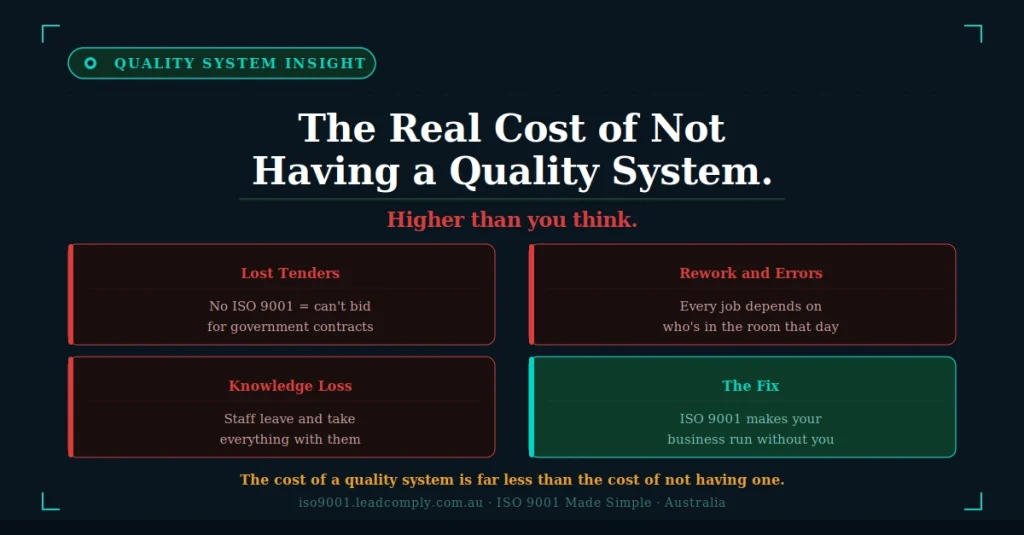
Ask a small business owner what it costs them to not have a formal quality system, and most will shrug. No system means no certificate, and no certificate just means missing out on the odd tender that asks for one. That is the whole cost, as far as most owners have ever priced it.
That is also almost never the real number. The actual cost of not having a quality system rarely shows up as a single line item. It shows up as the job that had to be redone, the staff member who left because nobody explained the process properly, the client who quietly stopped calling back, and the tender that went to a competitor for reasons that were never fully explained. None of those get coded as a “quality cost” in the accounts. They just look like normal cost of doing business, which is exactly why they never get fixed.
A number worth taking seriously, even secondhand
Quality researchers have been measuring this for decades under the name “cost of poor quality,” and the commonly cited range, drawn from manufacturing and production data, is that it can consume somewhere between 5 and 35 percent of revenue (source: Institute of Industrial and Systems Engineers, via
Jama Software’s summary of the research). That figure comes from factory floors, not five-person service businesses, so it should not be quoted as “this is what it costs you.” What it is useful for is scale. Even a business capturing a fraction of that range, in rework, in wasted staff time, in work that has to be done a second time, is looking at a number too large to write off as background noise.
The reason the number is so wide is that “poor quality” is not one cost. It is dozens of small, disconnected ones that never get added up in the same place.
Where it actually shows up in a business without a system
- Rework. The job gets done, then gets done again because a step got missed, and the second attempt is rarely billed to the client.
- Institutional memory walking out the door. When “how we do things” lives in one person’s head, every resignation is a small operational crisis, and every new hire relearns the same lessons from scratch.
- Repeat mistakes. Without a record of what went wrong last time and why, the same error resurfaces months later, usually on a bigger job.
- Lost tenders. Larger clients and government contracts increasingly ask for evidence of a formal quality process before they will even shortlist a supplier, regardless of the quality of the actual work.
- Customer churn that never gets explained. Clients rarely say “you were inconsistent.” They just quietly go elsewhere, and the business never connects the loss to its cause.
Individually, each of these looks like a one-off. Added together over a year, they are usually the single biggest drag on margin that a small business never measures.
Why this stays invisible for so long
A quality system’s absence does not send an invoice. There is no line item that says “cost of not having a documented process this month.” The costs above get absorbed into overtime, into “that’s just how this client is,” into staff turnover being treated as bad luck rather than a pattern. Nobody adds it up, so nobody sees the total, and a cost nobody can see is a cost nobody prioritises fixing.
This is the actual argument for a quality system like ISO 9001, and it has very little to do with the certificate on the wall. The certificate is the byproduct. The real value is a business that catches the mistake before it repeats, that keeps working the same way even when the one person who “just knows how it’s done” is on leave, and that can point to evidence rather than a promise when a bigger client asks how consistent the work actually is.
The bottom line
Not having a quality system is not a neutral, no-cost default. It is an ongoing, mostly invisible cost that gets paid in rework, in staff time, in lost tenders, and in clients who leave without saying why. The businesses that get ahead of it are not the ones with the fewest mistakes. They are the ones with a system that catches a mistake once and makes sure it does not happen the same way twice.
Sources
Institute of Industrial and Systems Engineers (IISE) — Cost of Poor Quality
Jama Software — What Is the Cost of Poor Quality (COPQ)?
If you want to see where this is actually costing your business, without a sales call or a credit card, the Lead Comply ISO 9001 Portal starts with a 5-question readiness check on how your business really runs. Try the free readiness check at the Lead Comply ISO 9001 Portal.
