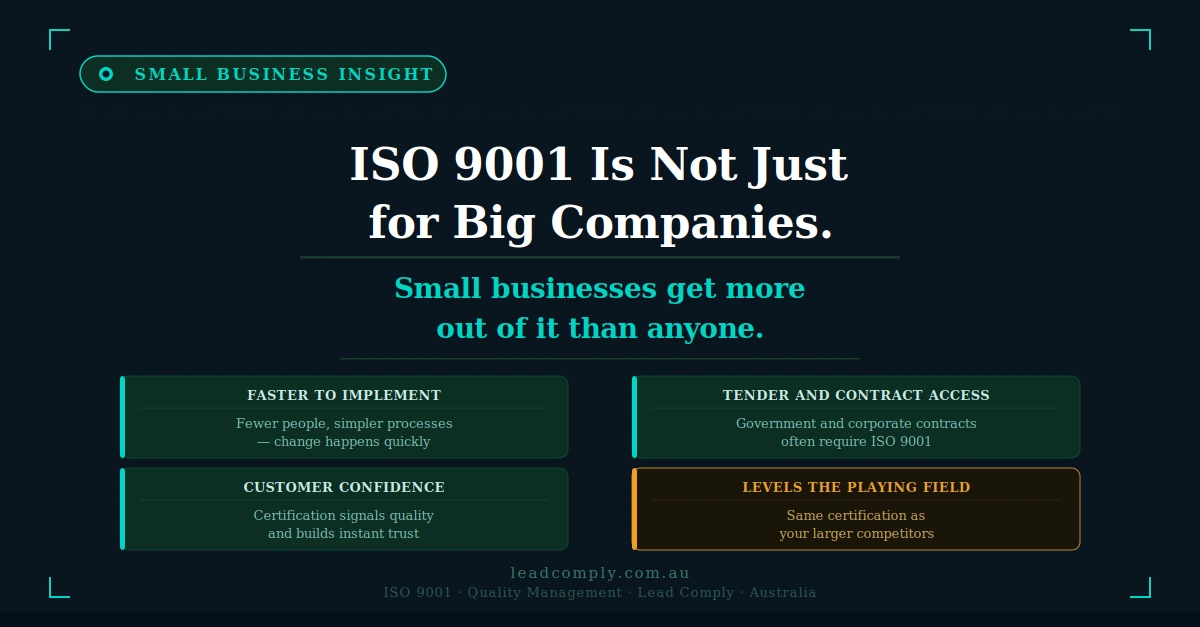
“ISO 9001 is for big companies.”
I hear a version of this almost every week, usually from someone running a business with five, ten, maybe fifteen people. It is one of the most common misconceptions I run into, and it is also completely back to front. The standard does not care how many people are on your payroll. It cares whether the way you run your business still works when you are not the one watching over every job.
The myth that keeps small business owners away
Most people picture ISO 9001 as something built for factories with a dedicated quality department, a compliance manager, and a filing system nobody outside head office understands. That image keeps a lot of small business owners from ever looking into it seriously. They assume it was written for someone else’s business, not theirs.
In reality, nothing in the standard requires a certain headcount, a certain revenue, or a certain org chart. What it requires is consistency, meaning your business delivers the same standard of work whether you are personally on site or not. That requirement applies exactly the same way to a fifteen-person business as it does to a fifteen-hundred-person one. The barrier has never been relevance. It has always been jargon and the assumption that this exercise wasn’t built with a small operation in mind.
The real problem is not size, it is memory
Here is what I see constantly with the tradies and small manufacturers I work with. One person, usually the owner, is the only one who actually knows how the job gets done properly. Everyone else is guessing, or asking. If that person is away, sick, or just flat out, the mistakes creep back in. Not once. Twice. Sometimes three times, same mistake, same cost.
That is not a big-company problem. That is a five-person problem. If anything, it hits small businesses harder, because there is no second layer to catch it before it costs you money or a client. A large organisation can absorb one person’s knowledge gap because there are ten other people who half know the process too. A five-person business cannot. One person’s memory is the entire system, until it isn’t.
What ISO 9001 actually asks you to do
Strip away the jargon and ISO 9001 is really just this: write down how you already do the good work, so it does not live only in one person’s head. That is the whole idea. It is not a filing cabinet exercise. It is how you stop paying for the same mistake twice.
For a small business, this usually means a handful of things. A short, honest description of how your business actually operates. A record of what happens when something goes wrong, and what you did about it. Some way of making sure the person doing a job today does it the same way the person who trained them did it. None of that requires a quality department. It requires writing down what a good business already half-knows, and making sure it survives one person having a bad week, a holiday, or a career change.
Why small businesses get more out of it than big ones
I have spent over a decade implementing quality systems across manufacturing, healthcare, and gaming, and honestly, the businesses that get the most out of certification are rarely the ones with a dedicated quality department. They are the ones small enough that one missed step actually shows up on the bottom line.
In a large organisation, a single process failure often gets absorbed somewhere in the system before it reaches the customer. In a small business, it goes straight through. That is exactly why the discipline ISO 9001 asks for tends to pay off faster and more visibly for a small operation than a large one. You feel the improvement almost immediately, because you were feeling the absence of it just as directly beforehand.
You might be exactly who it’s for
If you have ever thought “we’re too small for this,” I would push back on that. Certification is not the finish line, it is the formal proof point for something worth doing regardless. The businesses I have watched get the most value out of this process were never the biggest ones in the room. They were the ones where the owner was tired of watching the same mistake happen twice, and decided to actually do something about it.
You might be exactly who it’s for.
Danny Huynh is the Founder of Lead Comply and a BSI Qualified Lead Internal Quality Auditor with over a decade of hands-on quality management system implementation across manufacturing, healthcare, and gaming industries. Lead Comply helps Australian small businesses work through ISO 9001 in plain English, with a free readiness check available at iso9001.leadcomply.com.au.
