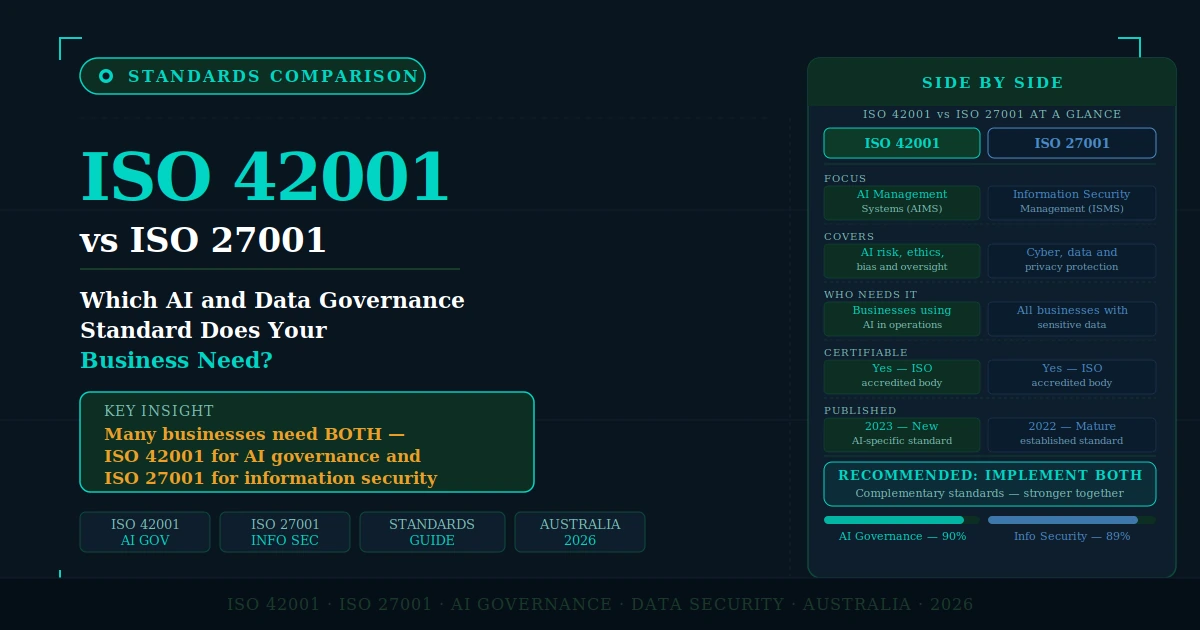
ISO 42001 vs ISO 27001: Which AI and Data Governance Standard Does Your Business Need?
Two ISO management system standards are increasingly relevant to Australian businesses operating with AI systems and sensitive data. ISO 27001 governs information security. ISO 42001 governs artificial intelligence. They address different risks, apply to different aspects of operations, and serve different governance purposes. Understanding the distinction is the starting point for making the right decision about which standard — or combination — your business actually needs.
Australian SMEs are navigating a compliance environment where AI governance and information security have both become strategic priorities. ISO 27001 is already well established — it is required for many government supplier panels and enterprise procurement frameworks across Australia. ISO 42001 is newer, published in December 2023, and is rapidly becoming relevant as the Privacy Act reforms and Australia’s broader AI governance agenda take shape. Many businesses are encountering both standards simultaneously and asking the same question: which do we actually need?
The answer depends on how your business uses AI, what information it handles, and what risks it needs to manage. This article provides a plain-English guide to both standards, a side-by-side comparison across every significant dimension, and a decision framework that Australian SMEs can use to determine whether they need one, the other, or both. For a detailed guide to ISO 42001 specifically, see Lead Comply’s full article: ISO 42001: The AI Governance Standard Australian Businesses Need to Know About.
| ISO/IEC 42001:2023 AI Management Systems: Published December 2023Governs how your AI systems are managed, monitored, and held accountable | ISO/IEC 27001:2022 Information Security Management: Updated October 2022Governs how your information is protected from security threats |
ISO 27001 — Information Security Management
ISO/IEC 27001:2022 is the international standard for Information Security Management Systems (ISMS). First published in 2005 and most recently updated in October 2022, it is the world’s most widely adopted information security standard, with over 70,000 certified organisations globally. The standard is available in Australia at standards.org.au as AS/NZS ISO/IEC 27001.
ISO 27001 addresses the security of information assets — the confidentiality, integrity, and availability of the information your business holds, processes, and transmits. It does not matter whether that information is held digitally or in physical form, processed by humans or automated systems. What matters is whether the organisation has identified its information security risks and implemented appropriate controls to manage them.
An ISO 27001-certified organisation has demonstrated that it can systematically identify information security threats, implement controls from the standard’s Annex A control set (93 controls in the 2022 version), and continually improve its security posture. For Australian businesses, ISO 27001 certification is a common requirement in government supplier prequalification, financial services procurement, and enterprise IT contracts.
ISO 42001 — Artificial Intelligence Management
ISO/IEC 42001:2023 is the international standard for Artificial Intelligence Management Systems (AIMS). Published in December 2023, it is the first internationally recognised framework for governing AI systems across their development, deployment, and ongoing management. The full standard is available at iso.org.
ISO 42001 addresses a different category of risk from ISO 27001. Where ISO 27001 asks “is our information secure?”, ISO 42001 asks “are our AI systems responsible, transparent, and accountable?” The standard requires organisations to identify the AI systems they use, assess the risks those systems create, implement appropriate governance controls, and maintain oversight of AI decision-making. For a complete explanation of the standard’s structure, see Lead Comply’s guide to ISO 42001 for Australian SMEs.
An ISO 42001-certified organisation has demonstrated that it governs its AI systems — whether self-developed or third-party tools — with appropriate transparency, human oversight, and accountability structures. As Australian regulation around AI use and automated decision-making develops through 2026, ISO 42001 provides the governance framework that satisfies both the international standard and the emerging Australian regulatory requirements.
Side-by-Side: What Each Standard Actually Does
| Dimension | ISO 42001 — AI Governance | ISO 27001 — Information Security |
| What it governs | How AI systems are developed, deployed, monitored, and held accountable — throughout their lifecycle | How information assets are protected from threats — confidentiality, integrity, and availability |
| Primary risk addressed | Risks from AI systems: bias, opacity, unintended consequences, lack of human oversight, automated decisions that harm individuals | Risks to information assets: data breaches, cyberattacks, unauthorised access, data loss or manipulation |
| Who needs it most | Any organisation that uses AI systems to make or influence decisions — particularly about people, products, or services | Any organisation that handles sensitive or valuable information — customer data, financial records, IP, employee data |
| What it manages | AI system inventory, AI risk assessment, transparency controls, human oversight mechanisms, AI impact assessments, accountability structures | Information asset register, risk assessment, 93 Annex A controls covering access management, cryptography, physical security, incident management, and more |
| Certification benefit | Demonstrates trustworthy, responsible AI governance to clients, regulators, and partners | Demonstrates systematic information security management — widely required in government and enterprise procurement |
| Australian regulatory relevance | Privacy Act AI disclosure requirements (December 2026 anticipated) · Australian AI Ethics Framework · Mandatory disclosure of automated decision-making | Privacy Act 1988 (data protection obligations) · Government supplier prequalification · IRAP (Information Security Registered Assessors Program) context |
| Standard maturity | New — published December 2023. Growing rapidly as AI regulation develops | Mature — established since 2005, updated 2022. Over 70,000 certified organisations globally |
| Common structure | Yes — both use the Annex SL High Level Structure shared by ISO 9001, ISO 14001, ISO 45001, and other management system standards | Yes — Annex SL structure. Fully compatible with ISO 42001 in an integrated management system |
| Typical Australian adoption | Emerging — particularly relevant for Professional Services, Technology, Healthcare, Financial Services, and AI-forward SMEs | Established — Technology, Financial Services, Government suppliers, Healthcare, and any business handling sensitive data |
| 🎓 FROM LEAD COMPLY’S COMPLIANCE EXPERIENCE The question Lead Comply hears most often when businesses encounter both standards is: “If I already have ISO 27001, do I need ISO 42001 as well?” The short answer is: increasingly, yes — if your business uses AI systems that process personal information or make decisions affecting individuals. ISO 27001 governs whether the information processed by your AI system is secure. ISO 42001 governs whether the AI system processing that information is trustworthy, transparent, and held accountable. These are different questions about different risks. An organisation can have excellent information security (ISO 27001) while its AI systems make biased, opaque, or unaccountable decisions (which ISO 42001 addresses). And an organisation can have responsible AI governance (ISO 42001) while its underlying information security controls are inadequate (which ISO 27001 addresses). The two standards are complementary, not substitutes. Which one to pursue first depends on which risk is more immediate for the business. |
When You Need ISO 27001
ISO 27001 is the right priority when information security risk is the primary concern. This typically applies when:
- Your business handles large volumes of sensitive personal information — financial records, health data, legal files, employee data — and a breach would create significant liability
- Government contracts or enterprise procurement require ISO 27001 certification as a prequalification condition
- Your clients or partners have asked for evidence of systematic information security management
- Your business has experienced a security incident and needs to demonstrate remediation and ongoing controls
- Your business operates in financial services, healthcare, legal services, or other sectors where information security is a core professional obligation
ISO 27001 does not specifically govern AI systems — but it does apply to the information those systems process. An organisation pursuing ISO 27001 certification while using AI tools should ensure those AI tools are included in the information asset register and risk assessment. The ISO 42001 standard can then address the AI-specific governance layer.
When You Need ISO 42001
ISO 42001 is the right priority when AI governance risk is the primary concern — particularly in the context of the emerging Privacy Act AI disclosure requirements anticipated for December 2026. ISO 42001 applies when:
- Your business uses AI systems that influence decisions about individuals — credit assessment, employment screening, customer service routing, content recommendations, risk scoring
- Your business develops AI systems or AI-powered products for clients and needs to demonstrate responsible AI governance
- You need to prepare for the Privacy Act AI disclosure requirements, including documenting how AI systems use personal information and establishing human review pathways for significant automated decisions
- Your clients or partners in regulated sectors — financial services, healthcare, government — are asking about your AI governance framework
- Your business is in a sector where AI use is growing rapidly — professional services, real estate, healthcare, education — and you want to establish governance ahead of regulatory requirements
For more on which Australian businesses are affected by AI governance requirements and what those requirements involve, see Lead Comply’s guide: AI Governance for Australian SMEs — Do You Need ISO 42001?.
When You Need Both
The majority of Australian businesses that use AI systems to process personal information will eventually need both standards — because they address different layers of the same problem. ISO 27001 protects the information. ISO 42001 governs how AI processes that information.
| Scenario | ISO 42001 | ISO 27001 |
| AI-powered technology company developing software products that process personal data | Essential — governs how AI systems are designed and accountable | Essential — governs how the data those systems process is secured |
| Professional services firm using AI tools for client work (e.g. document review, financial modelling) | Highly relevant — Privacy Act AI requirements and client accountability | Relevant — client data handled in AI tools must be secured |
| Healthcare provider using clinical decision support AI | Essential — AI governance directly affects patient safety | Essential — health information is sensitive under the Privacy Act |
| Small retail or hospitality business with basic IT and no AI use | Not yet relevant | Relevant if handling significant customer data; otherwise low priority |
| Real estate agency using AI-powered CRM and automated client communications | Relevant — AI tools process personal information and influence communications | Relevant — customer identification and financial data must be protected |
| Government contractor or regulated financial services firm | Growing relevance as AI use increases | Almost certainly required — standard government and financial services requirement |
The Five-Question Decision Framework
If you are still unsure which standard applies to your business, work through these five questions. The answers determine your starting priority.
| # | Question | If YES → ISO 42001 | If YES → ISO 27001 | If YES to both → Both |
| 1 | Does your business use AI systems that make or influence decisions about individuals? | Core use case for ISO 42001 | Less directly — unless AI processes sensitive data | Both if the AI system handles personal information |
| 2 | Does a client, government body, or procurement panel require a specific certification? | Certification bodies increasingly accepting ISO 42001 | ISO 27001 most commonly mandated in tender requirements | Both if multiple standards are specified |
| 3 | Are you subject to the Privacy Act AI disclosure requirements anticipated from December 2026? | Yes — ISO 42001 directly addresses these requirements | Indirectly — ISO 27001 covers data protection but not AI disclosure | Both if the AI system also handles sensitive personal information |
| 4 | Has your business experienced or is it at risk of a data breach or cyberattack? | Not directly relevant unless the breach involved AI systems | Yes — ISO 27001 risk assessment and Annex A controls address this directly | Both if AI systems are part of the security risk landscape |
| 5 | Does your business develop or supply AI systems, tools, or AI-powered products to other organisations? | Yes — ISO 42001 demonstrates responsible AI governance to clients | Relevant if those products process sensitive information | Both for AI product companies handling client data |
The Integration Opportunity
Because both ISO 42001 and ISO 27001 use the Annex SL High Level Structure — the common framework shared by ISO 9001, ISO 14001, ISO 45001, and other management system standards — they can be implemented as an integrated management system rather than two separate frameworks.
An integrated management system using all three standards (ISO 9001 for quality, ISO 27001 for information security, and ISO 42001 for AI governance) shares a single context analysis, stakeholder framework, risk management approach, internal audit program, management review process, and continual improvement methodology. The overlap significantly reduces the documentation burden compared to three separate standalone systems.
For Australian businesses already certified to ISO 9001, adding ISO 27001 and ISO 42001 to create an integrated governance framework is a natural progression that reflects the full scope of modern business risk management. Lead Comply’s ISO 42001 practice is designed with this integration path in mind — building AI governance frameworks that work alongside existing management systems rather than adding a separate compliance burden.
| 📋 WHAT GOES WRONG IN PRACTICE — WHAT LEAD COMPLY SEES Three standard selection mistakes Lead Comply identifies when Australian SMEs approach AI and information security governance for the first time: 1 — Assuming ISO 27001 covers AI governance. A business with strong ISO 27001 controls assumes it is also managing AI governance risk. ISO 27001 governs information security — not AI accountability, transparency, or automated decision-making oversight. A business can be fully ISO 27001 compliant while its AI systems are biased, opaque, and ungoverned. The Privacy Act AI disclosure requirements will make this gap visible. 2 — Pursuing ISO 42001 without addressing information security. A business implementing ISO 42001 to manage AI governance risk while its underlying information security controls are inadequate has solved the accountability problem while leaving the data protection risk unmanaged. AI systems that process sensitive personal information create both AI governance risk (ISO 42001) and information security risk (ISO 27001) simultaneously. 3 — Treating both standards as future projects while AI use grows today. The most common position Lead Comply finds is businesses using multiple AI tools across their operations without any governance framework for either information security or AI accountability. The Privacy Act AI disclosure requirements anticipated for December 2026 will make this position untenable for Privacy Act-covered entities. Starting with ISO 42001 now addresses the most immediately relevant regulatory requirement while creating the foundation for ISO 27001 integration. |
| ✓ THE RIGHT STARTING POINT FOR MOST AUSTRALIAN SMEs IN 2026 – If AI use is your primary governance challenge — start with ISO 42001. The Privacy Act AI requirements are arriving. ISO 42001 addresses them directly. – If information security certification is required for procurement — start with ISO 27001. Government and enterprise panels commonly specify ISO 27001. Address that first. – If both AI governance and information security are priorities — implement both. The Annex SL structure makes integration efficient. Lead Comply can advise on the sequencing and shared framework design. – If you already have ISO 9001 — you have the management system foundation for both. Adding ISO 42001 and ISO 27001 to an existing ISO 9001 system is significantly more efficient than building standalone frameworks from scratch. |
| Frequently asked questions — ISO 42001 vs ISO 27001: Can I get certified to both ISO 42001 and ISO 27001 at the same time? — Yes. An integrated management system audit can cover multiple standards simultaneously. BSI Group, SAI Global, and Bureau Veritas all offer combined certification audits. The efficiency gains from integration make this the preferred approach for most businesses pursuing both. Is ISO 42001 recognised in Australian government procurement the same way ISO 27001 is? — Not yet at the same level. ISO 27001 has a longer established history in government procurement requirements. ISO 42001 is emerging and expected to appear in procurement criteria as AI governance regulation matures. Implementing ISO 42001 now positions the business ahead of those requirements. We do not build AI — we just use third-party AI tools. Does ISO 42001 still apply? — Yes. ISO 42001 applies to organisations that deploy AI systems, not only those that build them. Using a third-party AI tool to make or influence decisions about individuals creates ISO 42001 governance obligations regardless of whether you developed the tool. Which certification does Lead Comply support? — Lead Comply’s practice focuses on ISO 42001 AI governance for Australian SMEs. For ISO 27001, Lead Comply can advise on the relationship between the two standards and the integration opportunity, and refer to appropriate partners. |
Book a free 30-minute Clarity Call with Lead Comply. In 30 minutes you will know how your AI tool use maps to ISO 42001, what the Privacy Act AI requirements mean for your business, and what the right governance starting point is.
