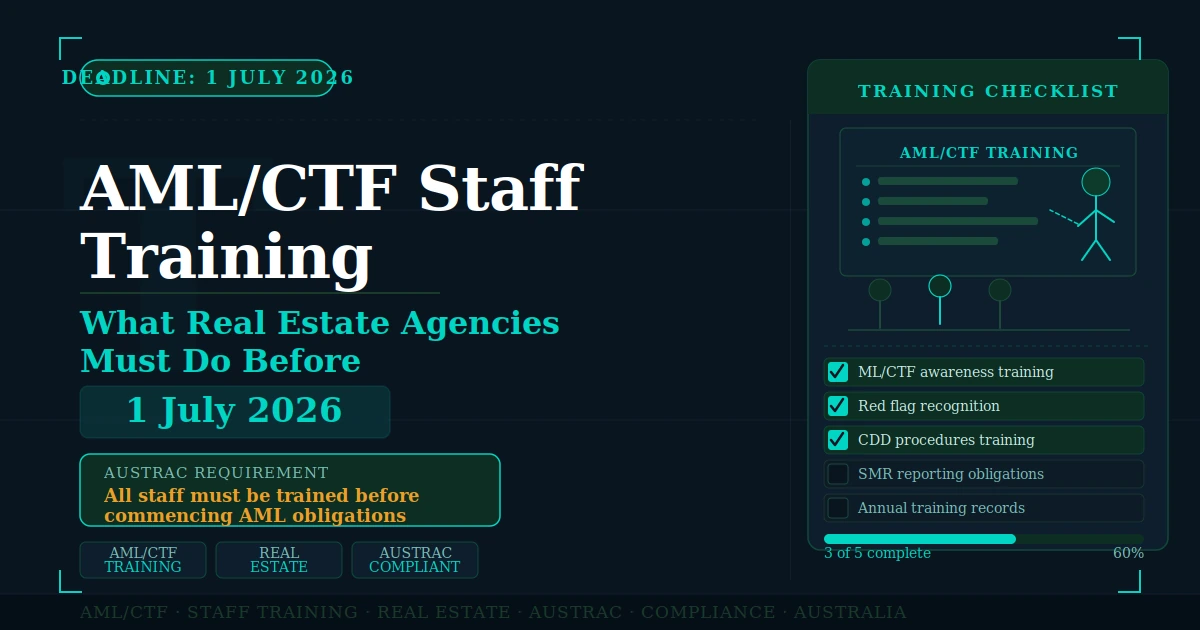
AML/CTF Staff Training: What Real Estate Agencies Must Do Before 1 July 2026
Staff training is not the most complex of the nine AML/CTF obligations but it is the one most likely to be done inadequately. A one-page policy memo, a generic online course, or a verbal briefing does not meet the AUSTRAC standard. Here is what real estate agencies must actually do.
When AUSTRAC examines a real estate agency’s AML/CTF compliance program, staff training is one of the first areas it assesses — and not just whether training was delivered, but whether the training covered the right content, whether it reached the right people, and whether completion was properly documented.
The reason is straightforward. Every other AML/CTF obligation including Customer Due Diligence, Suspicious Matter Reporting, Sanctions Screening depends entirely on staff who understand what they are looking for and what they are required to do. An agency can have a well-designed AML/CTF program on paper and be systematically non-compliant in practice if the people delivering the service have not been properly trained.
This guide covers the staff training obligation in full which covers who must be trained, what the training must cover, how it must be delivered and documented, and what the ongoing obligation looks like after 1 July 2026.
| ⚠️ STAFF TRAINING DEADLINE — 1 JULY 2026 Staff training must be completed BEFORE your agency commences providing designated services under the AML/CTF framework. For most real estate agencies, that date is 1 July 2026. AUSTRAC requires training to be in place at commencement, not scheduled for completion after the agency is already operating as a reporting entity. An agency that is enrolled with AUSTRAC, has an AML/CTF program, but has not trained its staff has met two of the nine obligations and failed the third. |
The Legal Basis for the Staff Training Obligation
The staff training requirement for real estate agencies derives from the AML/CTF Act 2006 and the AML/CTF Rules. Under the Act, every reporting entity must include in its AML/CTF Program Part A the procedures for staff training covering the nature, timing, and frequency of training across the organisation.
AUSTRAC’s guidance for Tranche 2 entities makes clear that training must be tailored to the reporting entity’s designated services and risk profile. A generic AML/CTF course that covers the framework broadly without reference to real estate transactions, property-specific red flags, or the nine obligations applicable to real estate agencies does not satisfy this requirement.
The training obligation is not a one-time event. It is an ongoing obligation that requires regular refresher training, training for new staff before they provide designated services, and updated training whenever the AML/CTF program changes materially or AUSTRAC issues new guidance. For further reference, the AML/CTF Act 2006 is available at legislation.gov.au and AUSTRAC’s training guidance at austrac.gov.au.
| 🎓 FROM LEAD COMPLY’S COMPLIANCE EXPERIENCE In designing and delivering AML/CTF staff training programs across multi-site operations in a regulated industry, the most consistent challenge is not content, it is reach and documentation. Most agencies can identify what needs to be covered. The gap is ensuring that every person who provides a designated service has received the training, understood it, and had their completion formally recorded, before they do anything that counts as a designated service. In a real estate agency context, this means the principal, all licensed agents, sales associates, and any staff who conduct client-facing activities connected to property transactions. The training program must be designed to reach all of them, not just the compliance officer. |
Who Must Be Trained
The staff training obligation is not limited to the principal or the compliance officer. AUSTRAC requires training to be provided to all staff who are involved in providing designated services or who may be required to identify or report suspicious matters.
| Staff Category | Training Required? | Priority |
| Principal licensee / agency principal | Yes — must understand all nine obligations and the agency’s AML/CTF program | Highest — training must be complete before 1 July 2026 |
| AML/CTF compliance officer | Yes — must understand the full program and the SMR escalation procedure | Highest — must be trained and authorised to lodge SMRs before 1 July 2026 |
| Licensed real estate agents | Yes — CDD, red flags, escalation, tipping off prohibition | High — all licensed agents before they provide designated services |
| Sales associates and property managers involved in sales | Yes — if they have any client contact in a designated service context | High — before involvement in any designated service transaction |
| Administrative staff who process client identification | Yes — understanding of CDD requirements and record keeping | Medium — before handling identity documents or client verification records |
| Property management only staff (no involvement in sales) | Not required for designated service purposes | Lower — but awareness training is good practice |
What AML/CTF Staff Training Must Cover
AUSTRAC requires the content of AML/CTF training to be appropriate to the employee’s role and responsibilities. This means different staff may require different depth of training — but there is a core set of topics that every person who provides designated services must understand.
| Required Training Content | Why This Content Is Required |
| What AML/CTF Tranche 2 is and why real estate is now regulated | Staff must understand the legislative context, why they are doing this and what the consequences of non-compliance are for the agency and for them personally |
| The agency’s AML/CTF Program — Part A and Part B | Staff must know the agency’s specific policies and procedures, not just the legal framework. The program is the document they are expected to follow |
| Customer Due Diligence requirements — who to identify, what to collect, how to verify | The practical steps of collecting and verifying client identity must be understood by everyone who onboards clients |
| Beneficial owner identification — particularly for companies, trusts, and SMSFs | The step most commonly missed. Staff must understand that identifying the entity is not sufficient without identifying the natural person behind it |
| Red flags and suspicious transaction indicators specific to real estate | Generic red flags are not sufficient. Staff must recognise the specific indicators relevant to property transactions in your market |
| Suspicious Matter Reporting — the suspicion threshold, the 24-hour rule, and the tipping off prohibition | Staff must know what constitutes a suspicion, who to escalate to, and — critically — that they must not disclose the suspicion to the client |
| Sanctions and PEP screening — what it is and how the agency conducts it | Staff must understand the obligation to screen clients against sanctions lists and the significance of a Politically Exposed Person identification |
| Record keeping requirements — what records to keep and for how long | Staff who handle client documents or transaction records must understand the seven-year retention obligation |
| 🎓 FROM LEAD COMPLY’S COMPLIANCE EXPERIENCE The two training topics that consistently require the most attention in real estate agency contexts are the tipping off prohibition and beneficial owner identification. Tipping off is not intuitively obvious to staff who are accustomed to open, relationship-based client communication. The idea that you cannot tell a client you have concerns about their transaction, or even that you are reviewing it for compliance purposes requires genuine training to internalise. A verbal explanation at a team meeting is not sufficient. Staff need to understand specific scenarios and the consequences of a tipping off breach. Beneficial owner identification in company and trust transactions is similarly counterintuitive. The agency’s instinct is to deal with whoever is in the room. Training must make clear that the person in the room may not be the person who ultimately controls the funds, and that establishing that chain of ownership is the agent’s legal obligation, not an optional extra. |
How Training Must Be Delivered
AUSTRAC does not mandate a specific training delivery method but it does require that the training is appropriate, effective, and properly documented. The choice of delivery method should be determined by what will actually result in staff understanding their obligations, not by what is most convenient to administer.
| Delivery Method | What It Does Well | Where It Falls Short |
| Face-to-face workshop | Allows questions, discussion, and real-estate-specific scenarios. Strongest for internalising the tipping off prohibition and CDD judgment calls | Time-intensive, requires scheduling, and must be supplemented by written records of attendance and content |
| Online course (agency-specific) | Scalable, self-paced, and generates automatic completion records if properly configured | Generic AML/CTF courses that are not adapted to real estate do not meet the tailored content requirement |
| Written policy with acknowledgement | Low cost and easily documented | Does not constitute training — reading a policy is not the same as being trained to apply it |
| Video training module | Engaging and consistent delivery across a team, good for red flags and case studies | Must be supplemented by comprehension check or assessment to demonstrate understanding |
| Blended approach | Combines depth and reach workshop for core content, online module for refresher and new starters | Requires more program design investment but produces the strongest compliance outcome |
How Training Must Be Documented
Documentation of staff training is not optional. AUSTRAC requires reporting entities to maintain records that demonstrate training has been provided. These records must be retained for at least seven years and must be available for production during an AUSTRAC examination or audit.
A compliant training record for each staff member must include:
- Full name and role of the staff member
- Date the training was completed
- Description of the training content covered,not just a course title
- Delivery method, workshop, online, video, or blended
- Evidence of completion, attendance register, assessment result, or signed acknowledgement
- Name of the trainer or the provider if delivered externally
- Version of the AML/CTF program the training was based on
A training register that records only names and dates does not satisfy this standard. The record must be sufficient to allow AUSTRAC to assess what the staff member was trained on and how their understanding was verified.
| ⚠️ WHAT DOES NOT CONSTITUTE COMPLIANT TRAINING DOCUMENTATION These are the most commonly produced training records that AUSTRAC considers inadequate: An email to staff attaching the AML/CTF policy and asking them to read it. A meeting agenda item listed as “AML/CTF compliance update” with no supporting record of content. A generic online course completion certificate that does not identify real-estate-specific content. A signed acknowledgement that the staff member has received the policy, but not been trained on it. A training record with names and dates but no description of what was covered |
The Ongoing Training Obligation
The training obligation does not end on 1 July 2026. AUSTRAC requires reporting entities to conduct ongoing AML/CTF training across three ongoing triggers:
| Ongoing Training Trigger | What Is Required |
| New staff before they provide designated services | Every new agent, associate, or staff member who will be involved in designated services must be trained before they have any client-facing contact in that context, not during induction and not “as soon as possible” |
| AML/CTF program is updated materially | When your risk assessment is updated, your procedures change, or AUSTRAC issues new guidance that affects your program, affected staff must receive updated training. Change a procedure, train on the change. |
| AUSTRAC issues new guidance or the regulatory environment changes | The AML/CTF framework is actively evolving. Tranche 2 is bringing real estate into a regulatory environment that will develop over time. Training must keep pace with the framework. |
| Annual refresher training | Best practice and AUSTRAC expectation — an annual refresher cycle that ensures all staff who provide designated services maintain current knowledge of their obligations. |
| After a compliance incident or near-miss | Where a red flag was missed, a CDD step was skipped, or an SMR was lodged — the incident should trigger a training review for the staff involved and potentially the wider team. |
How Lead Comply Delivers AML/CTF Staff Training for Real Estate Agencies
Lead Comply’s AML/CTF staff training for real estate agencies is delivered as a core component of every program engagement, not as an optional add-on. The training is designed specifically for real estate operations, using real-estate-specific scenarios, red flags, and case studies that generic AML/CTF courses cannot provide.
- Training content tailored to your agency’s AML/CTF program. Staff are trained on your specific procedures, not a generic framework
- Role-appropriate depth; principal and compliance officer training covers full program management; agent and associate training focuses on CDD, red flags, escalation, and the tipping off prohibition
- Real-estate-specific red flag scenarios, cash payment scenarios, offshore purchaser cases, trust and company structures, and rapid resale patterns
- Comprehension assessment, a short assessment after each training session to verify understanding, not just attendance
- Compliant training register, a documentation template and completed register for every staff member, formatted for AUSTRAC examination requirements
- New staff onboarding module, a streamlined version for new starters before they first provide designated services
- Annual refresher training, scheduled as part of the ongoing compliance program
| 📋 WHAT GOES WRONG IN PRACTICE — WHAT LEAD COMPLY SEES The three most consistent staff training failures Lead Comply identifies when reviewing agency compliance programs: 1 — Training delivered to principals and compliance officers only, not to the licensed agents and associates who actually conduct client onboarding, present offers, and attend auctions. The obligation applies to everyone who provides a designated service and in most agencies, that is the agent in the field, not the person behind the desk. 2 — Training records that document attendance but not content. A list of names and a date is not a training record. AUSTRAC requires evidence that the training covered specific obligations relevant to the agency’s designated services, not just that a meeting was held. 3 — No training delivered before 1 July 2026: agencies that plan to “do training once they get the program sorted.” The training obligation is part of the program. You cannot operate as a reporting entity with an AML/CTF program that includes untrained staff. |
| ✓ WHAT A TRAINING-COMPLIANT REAL ESTATE AGENCY LOOKS LIKE All staff who provide designated services trained before 1 July 2026. Training content tailored to the agency’s specific AML/CTF program and real estate context. Role-appropriate training delivered: principals, agents, and administrative staff at appropriate depth. Comprehension assessment completed and results recorded for each staff member. Training register maintained with full content description, delivery method, and completion evidence. New starter training procedure in place, no new agent provides designated services before training· Annual refresher training scheduled and built into the ongoing compliance calendar. Training register retained and accessible for AUSTRAC examination: seven-year minimum |
| Frequently asked questions on AML/CTF staff training: Can we use an off-the-shelf online AML/CTF training course? – Only if it covers real-estate-specific content and your agency’s own program procedures. Generic AML/CTF courses do not meet the tailored content requirement. Does training need to be repeated every year? – AUSTRAC expects regular refresher training. Annual is the accepted standard — plus training whenever the program changes or a new staff member joins. What if a staff member refuses to complete training? – They must not provide designated services. An agency that allows untrained staff to conduct client onboarding is in breach of its AML/CTF obligations. Do contractors and referral partners need to be trained? – If they provide designated services on behalf of the agency, yes. If they are truly independent, no — but the relationship must be carefully assessed. |
About Lead Comply
Lead Comply is a Sydney-based compliance consultancy specialising in AML/CTF Tranche 2 program design for Australian SMEs. Our AML/CTF practice draws on more than six years of direct experience managing AML/CTF compliance programs in a regulated Australian industry — including staff training program design, delivery, and documentation across multi-site operations. This article reflects that operational experience alongside current AUSTRAC guidance published for Tranche 2 reporting entities.
Book a free 30-minute Clarity Call with Lead Comply. In 30 minutes you will know whether your training content, delivery, and documentation meet the AUSTRAC standard — and exactly what needs to change before the deadline.
