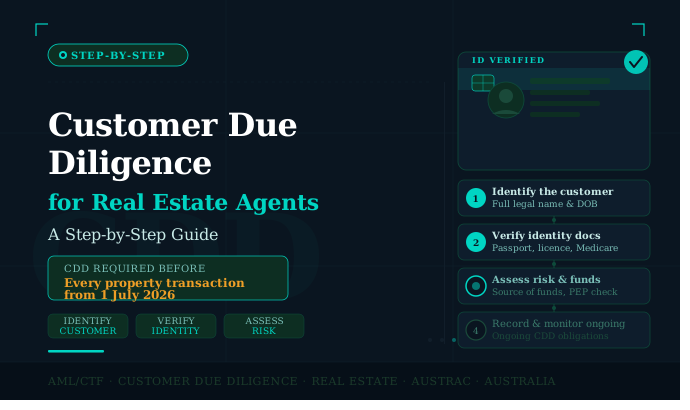
Customer Due Diligence for Real Estate Agents: A Step-by-Step Guide
Customer Due Diligence is the practical heart of AML/CTF compliance for real estate agents. It is the process of identifying and verifying every client before you provide a designated service — and it is an ongoing obligation, not a one-time task. Here is exactly what it requires and how to do it correctly.
Of all the AML/CTF obligations applying to real estate agencies from 1 July 2026, Customer Due Diligence is the one that most directly changes the day-to-day experience of working with clients. It requires agents to collect and verify identity information at the start of every client relationship — and to maintain that information throughout the relationship.
Most real estate agents already collect some client information. What changes under Tranche 2 is that collection and verification become a formal legal obligation, with specific requirements for what must be collected, how it must be verified, and what happens when verification cannot be completed.
This guide covers the CDD obligations step by step — what standard CDD requires, when Enhanced Due Diligence applies, how to handle the four main client types, and what to do when a client will not or cannot provide the information required.
| ⚠️ TIMING OF CDD — BEFORE THE DESIGNATED SERVICE CDD must be completed BEFORE you provide any designated real estate service. You cannot list a property, act for a buyer, or bid at auction before CDD is complete. Starting CDD partway through a transaction, or completing it after settlement, is a breach of the AML/CTF Act — regardless of how the transaction concludes. |
What Customer Due Diligence Actually Means
Customer Due Diligence — often called CDD or Know Your Customer (KYC) — is the process of establishing who your client actually is and verifying that identity using reliable, independent sources. Under the AML/CTF Act, CDD has three distinct components that must all be addressed.
| CDD Component | What It Requires |
| 1 — Identification | Collecting information that identifies the customer — their name, date of birth, residential address, and the nature and purpose of the business relationship. |
| 2 — Verification | Confirming that the identification information is accurate using reliable and independent sources — typically government-issued identity documents, or for non-individuals, corporate registry records. |
| 3 — Beneficial Owner | For non-individual clients — companies, trusts, partnerships — identifying the natural person or persons who ultimately own or control the client entity. This is separate from identifying the entity itself. |
All three components must be completed. An agency that collects a client’s name and address but does not verify them against an identity document has completed identification but not verification. An agency that verifies a company client but does not identify the beneficial owner behind that company has incomplete CDD.
When CDD Must Be Completed
The CDD obligation is not limited to new clients. Under the AML/CTF Act, real estate agencies must conduct CDD in each of the following circumstances:
- Before providing any designated service for the first time to a new client
- When an existing client returns after a period of inactivity — particularly if circumstances have changed
- When you become aware that information previously collected about a client may no longer be accurate or current
- When the client’s transaction or behaviour triggers a risk factor that warrants re-verification
- When your AML/CTF Program requires periodic review of client information as part of ongoing monitoring
The obligation is triggered by the nature of the service — not the amount of the transaction. There is no minimum transaction threshold below which CDD is not required. A $200,000 property sale requires the same CDD as a $20,000,000 commercial transaction.
CDD for the Four Main Client Types
The specific information required for CDD depends on the type of client. Real estate agencies encounter four main client categories — each with different identification requirements.
| 👤 Individual Clients: Full legal name — as it appears on government-issued identity documentation. Date of birth: Residential address — not a PO box. Verify using: current Australian driver’s licence, current Australian or foreign passport, or Medicare card combined with a secondary document> For foreign nationals: passport plus proof of Australian residential address> Face-to-face verification preferred — non-face-to-face requires additional controls |
| 🏢 Australian Company Clients: Company name and ACN — as registered with ASIC. Registered office address. Directors — full names of all directors. Verify using: ASIC company search (asic.gov.au)Beneficial owner identification — identify any individual who directly or indirectly holds 25% or more of the shares, or who exercises effective control over the company. If a corporate trustee is involved — complete CDD for the trust separately (see Trust Clients below) |
| 📋 Trust Clients: Trust name, Trustee details — complete CDD on each trustee (individual or corporate)Beneficiaries — identify the class of beneficiaries or named beneficiaries. Trust deed — sight the trust deed to verify the trust’s existence and structure. Beneficial owner identification — identify the natural person(s) who are the ultimate beneficiaries or who exercise effective control over the trust SMSF trusts — verify via ATO Super Fund Lookup |
| 🤝 Partnership and Other Entity Clients: Partnership name and nature of the business Partners — complete CDD on each partner as if they were an individual client. Governing document — sight the partnership agreement if available Beneficial owner identification — identify any partner with significant ownership or control. For other entity types — follow the general principle: verify the entity’s existence through reliable official sources and identify all natural persons with ultimate ownership or control |
Beneficial Owner Identification — The Most Commonly Missed Step
Beneficial owner identification is the component of CDD that most real estate agencies miss when self-implementing. It is also one of the most important — because the most common money laundering technique in Australian real estate is using corporate or trust structures to conceal who is actually purchasing the property.
A beneficial owner is a natural person — a real human being — who ultimately owns or controls the client. For the purposes of CDD, AUSTRAC considers the following to be indicators of beneficial ownership:
- Holding 25% or more of the shares or voting rights in a company
- Having the right to appoint or remove the majority of directors
- Exercising effective control over a company, trust, or other entity by any other means
- Being a named beneficiary of a trust, or belonging to a class of beneficiaries that is readily identifiable
- Being the settlor of a trust if the settlor retains control or influence over the trust
If no natural person can be identified as the beneficial owner after a reasonable investigation — which can happen with complex offshore structures — you must identify and verify the senior managing official of the entity and document why beneficial owner identification was not possible.
| ⚠️ BENEFICIAL OWNER — THE PROPERTY PURCHASER IS NOT ALWAYS THE BENEFICIAL OWNER The person signing the contract of sale is not necessarily the beneficial owner of the funds being used to purchase. Where a company or trust is purchasing property: · The company or trust is the client — but the beneficial owner may be an individual several layers removed from the immediate transaction· You must trace the ownership structure to identify the natural person at the top· Accepting “the director” as the beneficial owner without investigation is not sufficient. This step is what distinguishes a genuine CDD program from a compliance checkbox exercise. |
Enhanced Due Diligence — When Standard CDD Is Not Enough
Standard CDD applies to most clients. Enhanced Due Diligence — EDD — applies when the risk associated with a particular client or transaction is elevated. EDD requires additional information and a higher level of scrutiny.
| EDD Trigger | What Additional Steps Are Required |
| Politically Exposed Person (PEP) — client holds or has held a prominent public position | Obtain senior management approval before proceeding. Establish source of wealth and source of funds. Apply enhanced ongoing monitoring throughout the relationship. |
| PEP associate — client is a close family member or known associate of a PEP | Treat with the same scrutiny as a PEP. Document the basis for the association and the enhanced measures applied. |
| High-risk jurisdiction — client is based in or funds originate from a high-risk country | Obtain additional information on the source of funds. Verify through additional reliable sources. Document the enhanced scrutiny applied. |
| Complex or unusual transaction — ownership structure or transaction terms have no clear commercial rationale | Obtain a written explanation from the client of the purpose and structure of the transaction. Document the outcome of your assessment. |
| Large cash or unconventional payment methods — deposits or payments outside normal settlement channels | Obtain evidence of the source of funds. Scrutinise the payment method and document your assessment of the ML/TF risk. |
| Client refuses or delays standard CDD | This itself is a red flag. Document the refusal and consider whether a Suspicious Matter Report is warranted. |
What to Do When CDD Cannot Be Completed
Sometimes a client will not or cannot provide the information required for CDD to be completed. The AML/CTF Act is clear about what must happen in this situation: you must not provide the designated service.
| Situation | Required Action |
| Client refuses to provide identification | Do not provide the designated service. Document the refusal. Assess whether a Suspicious Matter Report is warranted. |
| Client cannot verify their identity within a reasonable time | Do not proceed until verification is complete. If the client withdraws, document the circumstances and assess SMR obligations. |
| Beneficial owner cannot be identified | Document the steps taken to identify the beneficial owner. Identify the senior managing official as an alternative. Consider whether to proceed. |
| CDD incomplete — you proceed with the service | This is a breach of the AML/CTF Act. Do not do this. |
Declining to act for a client because CDD cannot be completed is not a breach of any obligation — it is compliance with your obligations. If a client withdraws when asked to complete CDD, that withdrawal is itself a red flag that should be documented and assessed for SMR purposes.
Ongoing CDD — The Obligation Does Not End at Settlement
CDD is not a one-time process completed at the start of a client relationship. The AML/CTF Act requires ongoing due diligence throughout the relationship. For real estate agencies, this means:
- Monitoring transactions conducted by the client to identify changes in risk profile
- Updating CDD information when you become aware that it may no longer be accurate
- Applying heightened scrutiny when a client’s circumstances change materially
- Re-completing CDD when an existing client returns after a significant period of inactivity
In practice, ongoing CDD for a real estate agency primarily means remaining alert to changes in the client’s circumstances and being prepared to update information when those changes affect the risk profile of the relationship. It does not require re-verifying every client every year — but it does require genuine attention to red flags throughout the engagement.
Common CDD Mistakes Real Estate Agencies Make
| Mistake | Why It Is a Compliance Problem |
| Starting CDD after the engagement begins | The obligation is to complete CDD before the designated service. Starting it on listing day or at contract signing is already too late. |
| Relying on the solicitor’s CDD as sufficient | Your CDD obligation is independent of your client’s solicitor. The solicitor’s verification does not discharge your obligation as a reporting entity. |
| Accepting a drivers licence photocopy without checking validity | CDD requires verification from reliable and independent sources. A photocopy that cannot be confirmed as current does not meet the standard. |
| Not identifying the beneficial owner of company or trust clients | Completing CDD on the entity without identifying the controlling natural person is incomplete CDD — one of the most commonly exploited gaps. |
| No documented CDD record | CDD that is not documented did not happen from a compliance perspective. You must be able to demonstrate what was collected and verified. |
| Treating EDD triggers as optional extra checks | EDD is mandatory when triggers are present — not a discretionary upgrade. Failing to apply EDD when a PEP or high-risk jurisdiction is identified is a breach. |
How Lead Comply Designs CDD Procedures for Real Estate Agencies
Lead Comply’s AML/CTF Program Part B for real estate agencies covers every aspect of the CDD obligation — designed around how your agency actually works, not how a generic template assumes it works.
- Step-by-step CDD procedures for individual, company, trust, and SMSF clients
- Beneficial owner identification methodology — specific to the ownership structures common in Australian real estate transactions
- EDD triggers and enhanced procedures — embedded in the program so agents know when and how to escalate
- CDD forms and record templates — ready to use from day one
- Non-face-to-face CDD controls — for agencies conducting remote or online client engagements
- Staff training on CDD — delivered, completed, and documented
| ✓ WHAT A CDD-READY REAL ESTATE AGENCY LOOKS LIKE · Written Part B procedures for all four client types in the AML/CTF Program· CDD completed before every listing, buyer engagement, or auction mandate· Beneficial owner identification documented for all company and trust clients· EDD triggers identified and escalation procedures in place· CDD records retained in a system accessible for 7 years· All agents who conduct client onboarding trained on CDD procedures· A clear internal process for what to do when CDD cannot be completed |
| Frequently asked questions on CDD: Can we use an online identity verification platform? — Yes, provided the platform meets AUSTRAC’s reliability and independence requirements for the identity documents used. Does CDD apply to tenants in property management? — Property management is not currently a designated service. CDD applies to selling, purchasing, and auctioning only. Do we need to re-do CDD for existing clients we have acted for before? — Yes, if you act for them again after a period of inactivity, or if their circumstances have changed materially. Can we share CDD with other agencies in a network? — Only in limited circumstances. Each reporting entity has its own CDD obligation — sharing records does not discharge the obligation. |
Book a free 30-minute Clarity Call with Lead Comply Consultant. In 30 minutes you will know whether your procedures cover individual, company, trust, and SMSF clients — and whether your beneficial owner identification will hold up under scrutiny.
