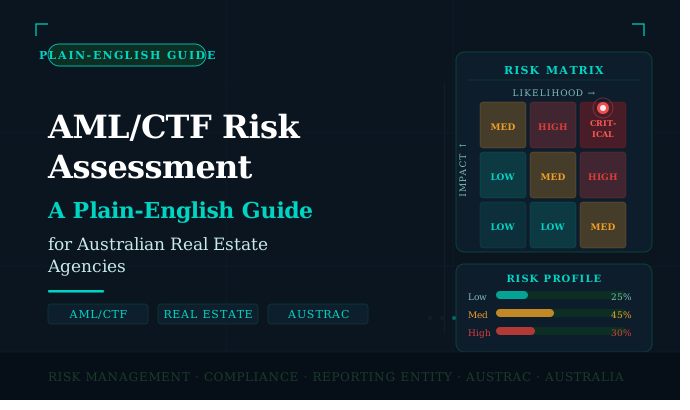
AML/CTF Risk Assessment: A Plain-English Guide for Australian Real Estate Agencies
The ML/TF Risk Assessment is not a box-ticking exercise. It is the legal foundation of your entire AML/CTF compliance program — and AUSTRAC will look for it first. Here is what it is, what it must cover, and how to get it right before the 1 July 2026 deadline.
When AUSTRAC assesses whether a real estate agency has met its AML/CTF obligations, the risk assessment is the first document it looks for. Not because it is the most complex obligation — it is not. But because every other part of your compliance program flows from it.
Your customer due diligence procedures, your suspicious matter reporting protocols, your staff training priorities — all of these are calibrated to the risks you have identified and documented in your risk assessment. A program built without a proper risk assessment is a program built on sand.
This guide explains what an AML/CTF risk assessment is, what the four AUSTRAC dimensions cover, what red flags look like in a real estate context, and what a defensible risk assessment actually requires.
| ⚠️ KEY DEADLINE Your ML/TF Risk Assessment must be completed BEFORE your AML/CTF Program is finalised.1 July 2026: AML/CTF obligations commence for real estate agencies.29 July 2026: AUSTRAC enrolment deadline. An AML/CTF program designed without a completed risk assessment does not meet AUSTRAC requirements. |
What Is an AML/CTF Risk Assessment?
A Money Laundering and Terrorism Financing Risk Assessment — referred to as an ML/TF Risk Assessment — is a formal, documented analysis of the money laundering and terrorism financing risks specific to your business. It is not a generic document. It is not a checklist downloaded from the internet. It is a considered examination of your actual clients, the services you provide, the ways you deliver those services, and the geographic markets you operate in.
AUSTRAC requires every reporting entity to conduct this assessment before designing its AML/CTF program. The logic is straightforward: if you do not understand your risks, you cannot design controls that address them. A program that does not reflect your actual risk profile is not a compliant program — even if it is comprehensive on paper.
The risk assessment must be reviewed and updated whenever your business changes materially, when new regulatory guidance is issued, and at a minimum once per year. It is a living document, not a one-time exercise.
| Why the risk assessment matters beyond compliance: Real estate has been identified by AUSTRAC as one of the highest-risk sectors for money laundering in Australia.The 2024 AUSTRAC Money Laundering in Australia report found that property transactions are frequently used to place, layer, and integrate criminal proceeds — including through complex ownership structures, offshore purchasers, and unusual financing arrangements. Understanding your specific risks is not just a legal requirement — it is how you protect your agency from facilitating a serious crime without knowing it. |
The Four Dimensions Every Risk Assessment Must Cover
AUSTRAC requires real estate agencies to assess their money laundering and terrorism financing risk across four specific dimensions. Each dimension must be considered separately and documented clearly.
| 👤1 | Customer Risk — Who Are You Acting For? Customer risk is the starting point for every real estate risk assessment. Different client types carry materially different risk profiles. Higher-risk customer types include: non-resident or foreign purchasers, clients who are Politically Exposed Persons (PEPs) or their associates, clients using complex ownership structures such as discretionary trusts, companies, or self-managed super funds, clients who are reluctant to provide identification documents, and clients whose stated source of funds does not match their apparent financial position. Lower-risk customer types include: Australian resident individuals purchasing a principal place of residence with conventional financing through an established lender. Your risk assessment must profile the actual types of clients your agency works with — not a theoretical average. An agency operating in a high-value market with frequent offshore purchasers has a fundamentally different customer risk profile than an agency in a regional market selling sub-$500,000 properties. |
| 🏠2 | Designated Service Risk — What Are You Doing for Them? The designated services for real estate agencies under Tranche 2 are selling, purchasing, and auctioning real property on behalf of another person. The nature of each service carries different risk characteristics. Selling on behalf of a vendor carries lower ML/TF risk than purchasing or bidding on behalf of a buyer — because the vendor is receiving funds rather than placing them. However, vendor-side transactions are not risk-free: criminal proceeds can be laundered through nominee vendors or manipulated settlement arrangements. Purchasing on behalf of a buyer is higher risk — particularly where the buyer is offshore, the purchase is funded through unconventional means, or the buyer is a non-individual entity. Auction transactions add complexity because of the speed of the transaction and the potential for third-party bidders. Your risk assessment must address each designated service type separately and document the specific risks associated with how your agency delivers them. |
| 💻3 | Delivery Channel Risk — How Do You Deliver Your Services? Delivery channel risk addresses how your agency interacts with clients and receives and transmits funds. Non-face-to-face transactions carry inherently higher risk than in-person interactions — because identity verification is harder and the opportunity for impersonation or fraud is greater. Higher-risk delivery channels include: online-only property transactions, remote identification and verification of clients, transactions where the agent never meets the client in person, and digital communication only with no face-to-face interaction. Lower-risk delivery channels include: in-person client meetings, face-to-face identification of all parties before any service is provided, and conventional licensed real estate transaction processes. If your agency conducts any significant volume of transactions without face-to-face client interaction — particularly for investment buyers — this must be reflected in your risk assessment and addressed through your enhanced due diligence procedures. |
| 🌏4 | Jurisdiction Risk — Where Are Your Clients From? Jurisdiction risk addresses the geographic exposure of your agency. Clients from certain countries carry elevated risk because of weak AML/CTF frameworks, high levels of corruption, or active designations on Australian or international sanctions lists. Higher-risk jurisdictions include: countries on FATF’s grey or black lists, countries subject to Australian sanctions administered by DFAT, countries with known significant corruption or organised crime activity, and offshore financial centres frequently used for asset concealment. Lower-risk jurisdictions include: Australia itself and countries with strong AML/CTF frameworks such as the UK, Canada, New Zealand, and Singapore. Your risk assessment must document the geographic profile of your client base — both current and anticipated. An agency in a CBD market with significant foreign investment exposure has materially higher jurisdiction risk than a regional agency. |
From Assessment to Rating — How to Document Your Risk Level
Once you have assessed each dimension, your risk assessment must produce an overall risk rating for your business. This rating then determines the intensity of the controls in your AML/CTF program.
| Risk Rating | What It Means | What Your Program Must Reflect |
| LOW | Minimal ML/TF exposure across all four dimensions | Standard CDD, basic training, routine record keeping |
| MEDIUM | Some elevated risk in one or more dimensions | Enhanced procedures for identified risk areas, additional training, closer monitoring |
| HIGH | Significant ML/TF exposure — multiple elevated dimensions | Enhanced Due Diligence as standard, senior oversight of high-risk transactions, robust monitoring |
Red Flags Specific to Real Estate ML/TF Risk
Your risk assessment should identify the red flags that are most likely to signal ML/TF risk in your specific market. These are not generic — they should be tailored to the types of clients and transactions your agency handles.
| Red Flag | Why It Matters |
| Cash payments or offers to pay cash outside of standard settlement | Cash cannot be traced — it is the primary vehicle for placing criminal proceeds into the property market |
| Purchaser is unknown to the agent and purchases without inspecting the property | Absentee or anonymous buyers are a classic layering technique |
| Price is significantly above or below market value | Inflated prices move money; deflated prices conceal true ownership value |
| Third party pays the deposit or purchase price on behalf of the buyer | Third-party payments obscure the true source of funds |
| Complex or unusual ownership structures with no clear commercial rationale | Trusts, companies, and offshore entities can be used to conceal beneficial ownership |
| Client is reluctant to provide identification or explains their identity documents are unavailable | Reluctance to be identified is itself a red flag under AML/CTF legislation |
| Transaction is rushed and client resists standard due diligence processes | Urgency is often used to bypass compliance checks |
| Source of funds is inconsistent with the client’s apparent financial position | A declared income of $80,000 purchasing a $3M property without clear explanation warrants scrutiny |
The Most Common Risk Assessment Mistakes
AUSTRAC has been clear that generic or template risk assessments do not meet the standard. Here are the mistakes Lead Comply sees most frequently when reviewing agency programs:
- Using a downloaded template without customising it to your agency’s actual client base and service profile
- Treating the risk assessment as a one-time document and never reviewing it
- Rating all four dimensions as “low” risk without genuine analysis — AUSTRAC will challenge this for agencies in high-value markets
- Failing to document the methodology used to arrive at the risk rating
- Not connecting the risk assessment conclusions to the controls in the AML/CTF program
- Completing the risk assessment after the AML/CTF program has already been designed
| ⚠️ AUSTRAC’S POSITION ON GENERIC RISK ASSESSMENTS AUSTRAC has explicitly stated that it expects risk assessments to reflect the real-world characteristicsof the reporting entity’s business — including the specific client types, transaction sizes, delivery channels,and geographic exposures that entity actually encounters. A generic risk assessment that could apply to any real estate agency will not satisfy this requirement.If your risk assessment reads like a template, it is a liability — not a protection. |
How Lead Comply Designs ML/TF Risk Assessments
Lead Comply’s approach to risk assessment starts with understanding your specific business — not applying a standard template.
Every Lead Comply risk assessment engagement begins with a structured intake process covering:
- Your current client profile — who you act for, in what markets, and at what transaction sizes
- Your designated services — selling, purchasing, auctioning, or a combination
- Your delivery channels — face-to-face, online, or remote transaction processes
- Your geographic exposure — domestic only, offshore buyers, or cross-border transactions
- Any existing compliance controls — policies, training, or procedures already in place
From this, Lead Comply produces a documented ML/TF Risk Assessment that:
- Rates each of the four AUSTRAC dimensions individually with supporting rationale
- Produces an overall business risk rating that is defensible in an AUSTRAC examination
- Identifies the specific red flags most relevant to your agency’s transaction profile
- Feeds directly into your AML/CTF Program Part A and Part B design
- Is written in plain English — not legal jargon — so your staff can actually use it
| ✓ WHAT A COMPLETE, DEFENSIBLE RISK ASSESSMENT LOOKS LIKE A Lead Comply risk assessment is a standalone document — typically 8 to 15 pages — that covers: – Business overview and designated services. – Customer risk analysis with your specific client profile. – Service risk analysis for each designated service type. – Delivery channel analysis including non-face-to-face exposure. – Jurisdiction risk analysis based on your actual client geography. – Overall risk rating with documented methodology. – Key red flags relevant to your market and transaction types. – Review schedule and version control This document then directly drives your AML/CTF Program design — not the other way around. |
| Where to start: Not started → Book a free Clarity Call. A proper risk assessment takes 3–5 business days with Lead Comply. There is still time before 1 July 2026.Have a template risk assessment → Request a review. Template assessments routinely fail AUSTRAC scrutiny. Have a program but no clear risk assessment → Your program needs to be redesigned from the assessment up. |
Book a free 30-minute Clarity Call with Lead Consultant. In 30 minutes you will know your agency’s risk profile, whether your current risk assessment is defensible, and what your AML/CTF program needs to reflect.
