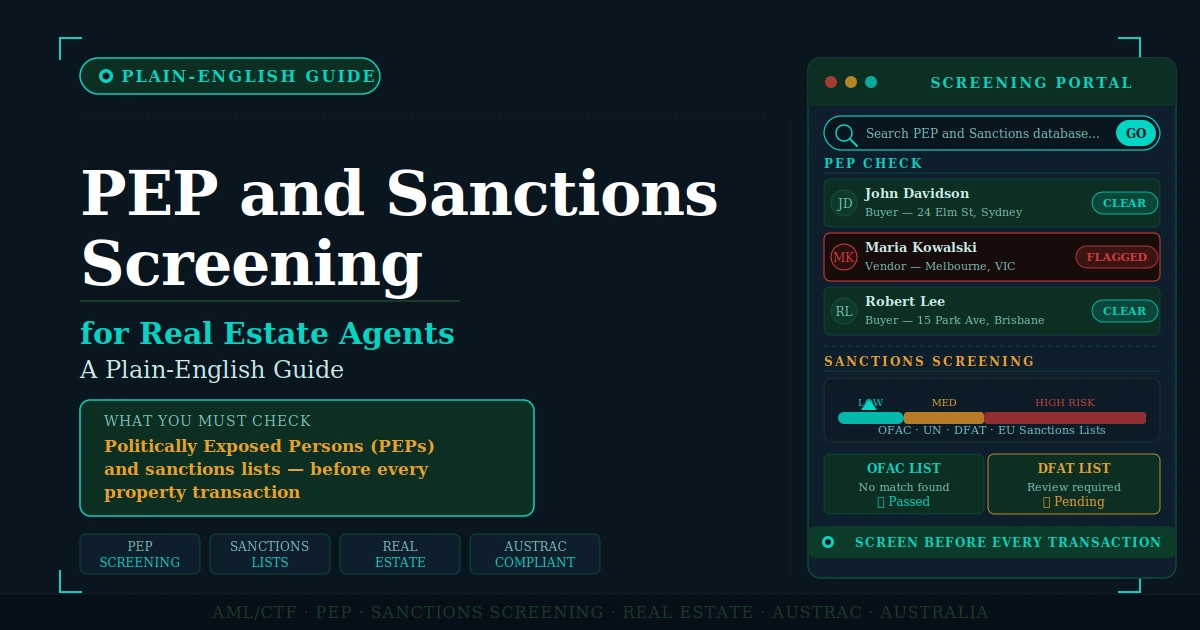
PEP and Sanctions Screening for Real Estate Agents: A Plain-English Guide
From 1 July 2026, every Australian real estate agency must screen clients against politically exposed person lists and Australian sanctions lists before providing a designated service. Most agents have never heard of either requirement. This guide explains both in plain English — who is a PEP, how to screen for them, what the sanctions obligation covers, and what to do when a match is identified.
The PEP and sanctions screening obligation sits within the Customer Due Diligence requirements of the AML/CTF Act 2006. It applies to every real estate agency that sells, purchases, or auctions property on behalf of another person. For most agencies, this is an entirely new process that does not resemble anything in their current client onboarding workflow.
Understanding both obligations correctly matters because the consequence of getting them wrong is significant. Providing a designated service to a sanctioned individual is a criminal offence. Failing to apply Enhanced Due Diligence to a PEP without appropriate approval is a breach of the AML/CTF Act. Neither outcome is fixed by good intentions.
This guide is written for principals and agents who need to understand these obligations practically, not theoretically. The AUSTRAC guidance on PEPs and sanctions is available at austrac.gov.au. The DFAT Consolidated Sanctions List is maintained at dfat.gov.au. The underlying legislative requirements appear in the AML/CTF Act 2006 at legislation.gov.au.
| ⚠️ TWO SEPARATE OBLIGATIONS — BOTH MANDATORY PEP screening and sanctions screening are distinct legal obligations. PEP screening identifies clients in positions of public trust who carry elevated corruption risk. Sanctions screening identifies clients who are prohibited persons under Australian law. A client can be a PEP without being sanctioned. A client can be sanctioned without being a PEP. Both checks must be performed for every client before a designated service is provided. Providing a designated real estate service to a sanctioned individual is a criminal offence. No exceptions apply based on the agent’s knowledge of the client or the transaction value. |
Part One: Politically Exposed Persons
What Is a Politically Exposed Person?
A Politically Exposed Person is an individual who holds or has held a prominent public position in a government body or international organisation. The AML/CTF Act and Rules identify three categories of PEP, each carrying different risk implications.
| PEP Category | Who It Covers | Risk Level |
| Foreign PEP | A person who holds or has held a prominent public position in a foreign government body — including heads of state, senior politicians, senior judicial officers, senior military officials, and senior executives of state-owned enterprises | Highest — automatic EDD required. Foreign PEPs carry the greatest risk of exposure to bribery and corruption. |
| Domestic PEP | A person who holds or has held a prominent public position in an Australian government body — including elected officials, senior public servants, senior judicial officers, and senior executives of government agencies | Elevated risk. Domestic PEPs require risk-based assessment. EDD is required where the risk assessment indicates elevated risk. |
| International Organisation PEP | A person who holds or has held a prominent position in an international organisation — such as the United Nations, World Bank, World Trade Organisation, or NATO | Elevated risk. Treated similarly to domestic PEPs. Risk-based assessment determines the level of due diligence required. |
| 🎓 FROM LEAD COMPLY’S COMPLIANCE EXPERIENCE The PEP definition is broader than most real estate agents expect when they first encounter it. In a regulated Australian industry context, PEP identification is a structured process — not a judgment call made at the point of client contact. The two areas that consistently create uncertainty in practice are family members and the “has held” element of the definition. Family members: the PEP definition extends to immediate family members and close associates fall three PEP categories. A person does not need to hold a public position themselves to be treated as a PEP. The spouse, children, parents, and close business associates of a foreign PEP are all subject to PEP-level due diligence. The “has held” element: a person who previously held a prominent public position remains a PEP for a period after leaving office. AUSTRAC guidance does not specify a fixed decommissioning period. The standard approach is to apply a risk-based assessment that considers the recency of the position, the nature of the role, and any ongoing influence the person may retain. |
Who Else Is Treated as a PEP?
The PEP definition extends beyond the person who holds the public position. The AML/CTF Rules require reporting entities to treat the following categories of individuals with the same level of scrutiny as the PEP themselves.
| Extended PEP Category | Who This Covers |
| Immediate family members | Spouse or de facto partner, children and their spouses or de facto partners, and parents of the PEP |
| Close associates | Individuals with a close business relationship with the PEP — including joint beneficial ownership of a legal entity or arrangement, or any other close business relationship |
| Beneficial owners who are PEPs | Where a company, trust, or other entity is the client, any PEP who is a beneficial owner of that entity must be identified and treated accordingly |
| Important: Being a PEP does not mean the person is involved in criminal activity. AUSTRAC is explicit on this point. PEPs are subject to enhanced scrutiny because their positions of public trust create potential exposure to bribery, corruption, and misuse of public funds. The obligation is to apply appropriate risk-based due diligence — not to treat PEPs as suspects or to refuse services automatically. A real estate agent is not required to decline to act for a PEP client. The agent is required to apply Enhanced Due Diligence before providing the service, obtain appropriate approval, and maintain heightened ongoing monitoring throughout the relationship. |
What to Do When a Client Is a PEP
When PEP screening identifies that a client is a PEP, an immediate family member of a PEP, or a close associate of a PEP, the following steps apply before any designated service is provided.
| 1 | Conduct Enhanced Due Diligence: Standard CDD procedures are not sufficient for PEP clients. Enhanced Due Diligence requires collecting additional information: the nature of the prominent position held, the period during which it was held, the source of the client’s wealth, the source of the funds for the specific transaction, and the purpose and intended nature of the business relationship. |
| 2 | Obtain Senior Management Approval: Before providing any designated service to a PEP client, approval must be obtained from a senior officer within the agency. This is typically the principal licensee or the AML/CTF compliance officer. The approval must be documented, including the basis on which the decision was made to proceed. |
| 3 | Apply Ongoing Enhanced Monitoring: The PEP relationship does not return to standard monitoring once the initial transaction is complete. PEP clients require ongoing enhanced monitoring throughout the business relationship — including heightened attention to subsequent transactions that may indicate changes in the client’s risk profile. |
| 4 | Document Everything: The EDD steps taken, the information collected, the approval obtained, and the rationale for proceeding must all be documented and retained for seven years. In the event of an AUSTRAC examination, the agency must be able to demonstrate that it identified the PEP status, applied the required enhanced scrutiny, and obtained appropriate approval before proceeding. |
Part Two: Sanctions Screening
What Is Sanctions Screening?
Sanctions screening is the process of checking whether a client appears on any Australian or international list of prohibited or restricted persons. Under Australian law, providing a financial service or property transaction service to a sanctioned individual or entity can constitute a criminal offence, regardless of whether the agent knew the client was sanctioned.
The primary sanctions framework relevant to Australian real estate agents has two components: the autonomous sanctions administered by the Department of Foreign Affairs and Trade (DFAT) under the Autonomous Sanctions Act 2011, and the United Nations sanctions implemented in Australia through the Charter of the United Nations Act 1945.
| Sanctions List | What It Covers and Where to Find It |
| DFAT Consolidated Sanctions List | Australia’s primary autonomous sanctions list, maintained by the Department of Foreign Affairs and Trade. Covers individuals and entities subject to targeted financial sanctions under Australian autonomous sanctions regimes. Accessible at dfat.gov.au/international-relations/security/sanctions. |
| UN Security Council Consolidated List | International sanctions imposed by the United Nations Security Council, implemented in Australia through the Charter of the United Nations Act 1945. Maintained at un.org/securitycouncil/sanctions/consolidated-list. |
| AUSTRAC Designated List | Specific designations under the AML/CTF Act related to terrorism financing. Administered by AUSTRAC at austrac.gov.au. |
| OFAC SDN List (contextual awareness) | The United States Office of Foreign Assets Control Specially Designated Nationals list. Not directly binding under Australian law but relevant for agencies with international clients or connections to US-linked transactions. |
How to Conduct Sanctions Screening
Sanctions screening must be conducted before providing a designated service and updated throughout the client relationship whenever circumstances change. The process involves checking the client’s full legal name, any known aliases, and date of birth against the relevant sanctions lists.
For most real estate agencies, the practical approach to sanctions screening involves one of three methods: manual screening against the DFAT Consolidated Sanctions List and UN list, use of a third-party screening platform that aggregates and updates multiple lists automatically, or integration of screening into the agency’s existing CRM or client onboarding system through an API-connected service.
| Screening Method | Practical Considerations | Suitability |
| Manual screening via DFAT website | Free. Requires the agent to search by name and review results. Updates are published by DFAT on an ongoing basis. | Suitable for small agencies with low transaction volumes. Time-intensive and dependent on consistent staff practice. |
| Third-party compliance platform | Paid service. Automates screening against multiple lists simultaneously. Provides audit trail and record keeping. Examples include LexisNexis, Dow Jones, or ACDC. | Recommended for agencies with regular transaction volumes. Significantly reduces manual effort and risk of error. |
| CRM-integrated screening | Screening embedded in the client onboarding workflow. Results recorded automatically in the client record. | Best practice. Requires integration setup but removes the screening step from the manual checklist. |
| 🎓 FROM LEAD COMPLY’S COMPLIANCE EXPERIENCE The screening process that most agencies underestimate is not the initial check — it is the on going monitoring requirement. Sanctions lists are updated frequently, sometimes daily. A client who passes screening on 1 July 2026 may appear on the DFAT Consolidated Sanctions List by September 2026 if new designations are added. In a regulated industry environment, sanctions screening is treated as a standing process, not a point-in-time check. The standard approach is to screen at onboarding, to re-screen at each subsequent transaction, and to subscribe to DFAT update alerts so that sanctions additions are identified promptly rather than discovered during an examination. Real estate agencies that conduct a single screening check and treat it as satisfying the on going obligation are creating exactly the kind of gap that an AUSTRAC examination will identify. |
What to Do When a Sanctions Match Is Identified
A sanctions match requires immediate action. The consequences of proceeding with a designated service for a sanctioned individual are serious enough to require escalation before any further steps are taken.
| ⚠️ WHEN A SANCTIONS MATCH IS FOUND — IMMEDIATE STEPS 1 — Do NOT proceed with the designated service. Stop the onboarding or transaction immediately. 2 — Do NOT tell the client they have matched a sanctions list. Disclosing this may constitute tipping off and could alert a sanctioned party to the screening process. 3 — Escalate to the compliance officer or principal immediately. 4 — Seek legal advice. The consequences of providing services to a sanctioned person are severe and legal guidance is warranted before any further action is taken. 5 — Consider whether an SMR should be lodged with AUSTRAC in addition to the sanctions response. 6 — Document all steps taken from the point of match identification. |
Note on false positives: screening systems will sometimes generate a match that does not correspond to the actual client. This is particularly common with common names. A false positive does not mean the screening process has failed. It means the agency must conduct additional verification to confirm whether the match relates to the actual client before proceeding. That verification process must be documented.
How Lead Comply Integrates PEP and Sanctions Screening into Your AML/CTF Program
Lead Comply builds PEP identification and sanctions screening directly into the AML/CTF Program Part B procedures for every real estate agency engagement. The program design covers:
- A written PEP identification procedure: the questions to ask, the sources to consult, and the escalation path when a PEP is identified
- EDD procedures for PEP clients: the additional information to collect, the approval process, and the ongoing monitoring standard
- A sanctions screening procedure: which lists to screen against, when to screen, and how to document results
- A match response procedure: the steps to follow when a potential PEP or sanctions match is identified, including the escalation path and documentation requirements
- Staff training on PEP and sanctions concepts: ensuring every agent who onboards clients understands what they are looking for and what to do when they find it
- Record keeping templates: formatted to document PEP status, screening results, and EDD steps for every client
| 📋 WHAT GOES WRONG IN PRACTICE — WHAT LEAD COMPLY SEES Three consistent failures appear in agency compliance programs when Lead Comply reviews PEP and sanctions screening procedures: 1 — PEP screening is treated as a single question on the CDD form: “Is this client a PEP?” Relying on client self-disclosure to identify PEP status is not a PEP screening process. Clients do not always identify themselves as PEPs. The screening obligation requires the agency to independently verify PEP status through reliable sources — not to ask and accept whatever answer the client provides. 2 — Sanctions screening is conducted once at onboarding and never repeated. The DFAT Consolidated Sanctions List is a live document. Sanctions designations are added and removed on an ongoing basis. A screening process that runs once at onboarding and treats the result as permanent does not meet the ongoing monitoring requirement. 3 — No procedure exists for what to do when a match is identified. Agencies that have a screening step in their process but no match response procedure are in the most dangerous position of all. A match identified and then not escalated correctly, because no one knew what to do, can result in a service being provided to a sanctioned individual despite the screening system working as intended. |
| ✓ WHAT A PEP AND SANCTIONS SCREENING COMPLIANT AGENCY LOOKS LIKE Written PEP identification procedure embedded in the CDD workflow — not relying on client disclosure. PEP categories understood by all staff who conduct client onboarding. Sanctions screening conducted against DFAT and UN lists before every designated service. Screening results documented for each client and retained for seven years. EDD procedure in place for PEP clients, including senior management approval requirement. Match response procedure documented: what to do, who to tell, and how to document it. Ongoing screening in place: re-screening at each subsequent transaction. DFAT update alerts subscribed to so new designations are identified promptly |
| Frequently asked questions on PEP and sanctions screening: Are we required to decline to act for a PEP client? — No. The obligation is to apply Enhanced Due Diligence, obtain senior management approval, and apply ongoing monitoring. Refusing to act for PEPs is not required and may raise separate legal issues. How do we know if a client is a PEP if they do not tell us? — PEP status must be verified through independent sources, not self-disclosure. AUSTRAC guidance identifies open-source research, commercial database services, and government records as acceptable verification methods. How often should we re-screen existing clients against sanctions lists? — At each subsequent designated service transaction at minimum. Best practice is to subscribe to DFAT update alerts and re-screen when a new designation is added that may relate to existing clients. What if we identify a potential PEP but are not certain? — Apply the PEP standard and conduct EDD. It is significantly better to apply EDD unnecessarily than to fail to apply it to a genuine PEP. |
Book a free 30-minute Clarity Call with Lead Comply. In 30 minutes you will know whether your screening procedures, Enhanced Due Diligence requirements, and match response protocol are properly designed and documented.
